
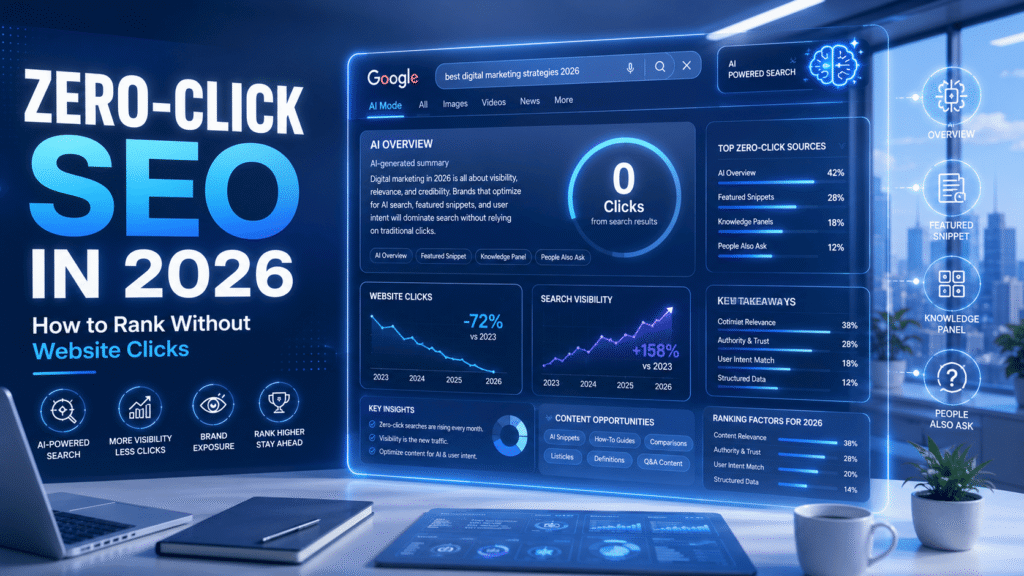
Zero-Click SEO in 2026: How Businesses Successfully Survive AI Search
Introduction: SEO Traffic Is Changing Faster Than Most Businesses Realize
If your website traffic has suddenly started decreasing even though your rankings still appear stable, you are not alone.
Thousands of businesses in 2026 are experiencing the same situation.
Their technical SEO is healthy.
Their pages are indexed.
Their backlinks still exist.
Their rankings may even look normal inside search results.
But traffic continues to fall.
For many businesses, this situation feels confusing at first.
Most website owners immediately assume:
- Google penalties affected their site
- their competitors became stronger
- their SEO agency failed
- their backlinks lost power
- their content stopped ranking
However, after analyzing modern search behavior deeply, a completely different reality becomes clear.
The biggest reason behind traffic decline in 2026 is not always rankings.
The biggest reason is the rise of zero-click SEO in 2026 and AI-powered search experiences.
Google is no longer behaving like a traditional search engine only.
It is becoming an AI-powered answer engine.
Users are increasingly receiving answers directly inside search results without clicking websites.
This changes the entire SEO industry.
And businesses that fail to adapt to this new AI search ecosystem may lose visibility, authority, and traffic over time.
However, businesses that understand zero-click SEO in 2026 early can still build strong future growth opportunities.
What Is Zero-Click SEO in 2026?
Zero-click SEO refers to search experiences where users receive answers directly inside search results without needing to click on websites.
Instead of opening multiple pages, users now often receive summarized AI-generated answers instantly.
This happens through systems such as:
- Google AI Overviews
- featured snippets
- People Also Ask boxes
- knowledge panels
- instant answer systems
- AI-generated search summaries
As AI-powered search continues evolving, more informational searches are becoming zero-click searches.
This means users may:
- get information faster
- avoid visiting websites
- trust AI summaries
- spend less time browsing traditional search results
This is one of the biggest SEO shifts happening right now.
Why Zero-Click SEO in 2026 Is Growing Rapidly
Google AI Overviews Changed Search Behavior
The rise of Google AI Overviews dramatically changed how users interact with search engines.
Previously, Google mainly displayed blue links that users clicked manually.
Now Google increasingly generates AI-powered answers directly inside search results.
This creates faster user experiences while reducing website clicks.
As AI systems improve, Google becomes better at:
- summarizing content
- understanding semantic intent
- extracting information
- answering questions directly
This changes how businesses must think about SEO.
Users Prefer Instant Information
Modern users prefer fast information.
Most users no longer want to open ten different pages to find one answer.
They prefer:
- quick summaries
- instant explanations
- AI-generated answers
- mobile-friendly search experiences
Google understands this behavior clearly.
That is why AI-powered search systems continue expanding aggressively.
Mobile Search Accelerated Zero-Click Behavior
Mobile search behavior significantly increased zero-click searches.
Mobile users usually want immediate answers with minimal scrolling.
AI Overviews fit mobile behavior perfectly because they reduce search friction.
This is one major reason why zero-click SEO in 2026 continues growing rapidly.
Why Businesses Are Suddenly Losing Organic Traffic
Many businesses built their entire marketing strategy around traditional organic traffic.
For years, the SEO formula was relatively simple:
- rank higher
- get more clicks
- increase traffic
- generate leads
However, AI-powered search disrupted this formula.
Now businesses may still rank while receiving fewer clicks.
This creates panic for many website owners.
But traffic decline does not always mean SEO failure.
Sometimes it simply means:
- Google already answered the query
- AI Overviews reduced click necessity
- users received summaries directly
- search behavior evolved
This distinction is extremely important.
Businesses that misunderstand this shift may make poor SEO decisions.
Does Zero-Click SEO Mean SEO Is Dead?
No.
This is one of the biggest misconceptions spreading across the digital marketing industry.
SEO is not dying.
SEO is evolving.
Traditional SEO focused heavily on:
- keyword rankings
- organic traffic
- click-through rates
- position tracking
However, modern SEO increasingly focuses on:
- semantic authority
- AI visibility
- brand trust
- topical expertise
- answer engine optimization
- entity recognition
The businesses that adapt to this new AI ecosystem early will likely dominate future search visibility.
The Biggest SEO Shift Happening Right Now
One of the biggest changes happening in SEO today is that visibility matters more than clicks alone.
Previously, SEO success was measured mainly through traffic volume.
Today, businesses must also think about:
- brand visibility
- AI citations
- authority signals
- semantic relevance
- topical trust
Modern AI systems increasingly choose authoritative sources instead of simply ranking pages based only on keywords.
This creates a major advantage for businesses building topical expertise early.
How Businesses Can Survive Zero-Click SEO in 2026
1. Build Strong Topical Authority
One of the most important strategies for surviving zero-click SEO in 2026 is building strong topical authority.
Google AI systems prefer websites deeply focused on specific subjects.
Businesses should stop publishing random disconnected blogs.
Instead, they should create connected topic ecosystems.
Example AI SEO topic cluster:
- Google AI Search
- AI Overviews
- AI SEO strategy
- Zero-click SEO
- future search optimization
- entity SEO
- semantic SEO
- topical authority
This creates stronger semantic relevance and helps AI systems understand expertise depth.
2. Structure Content for AI Readability
Modern AI systems strongly prefer content that is easy to scan and understand.
Businesses that want stronger AI visibility should structure their content clearly.
This includes using:
- clear H1 headings
- organized H2 sections
- logical H3 subsections
- bullet points
- tables
- FAQ sections
- short readable paragraphs
AI-powered search systems analyze structure very carefully.
Poorly formatted content becomes harder for AI systems to interpret and summarize.
This is why modern SEO is no longer only about keywords.
Structure itself became an SEO advantage.
3. Answer User Questions Directly
One major difference between traditional SEO and AI-powered SEO is how answers are delivered.
AI systems often extract direct answers from websites and display them immediately inside search results.
This means businesses should clearly answer important user questions early inside their content.
Examples include:
- What is zero-click SEO in 2026?
- Why is website traffic dropping?
- How do AI Overviews affect SEO?
- How can businesses survive AI search changes?
- What is the future of organic traffic?
Businesses that explain these questions clearly improve their chances of appearing inside AI-generated summaries.
4. Focus on Semantic SEO Instead of Only Keywords
Older SEO strategies focused heavily on repeating exact keywords.
Modern AI-powered search works differently.
Google AI systems now understand:
- semantic meaning
- topic relationships
- user intent
- content context
- entity associations
This means businesses should focus on complete topic coverage instead of excessive keyword repetition.
For example, a strong article about zero-click SEO in 2026 should naturally discuss:
- Google AI Overviews
- AI search optimization
- semantic SEO
- future search trends
- AI visibility
- topical authority
- answer engines
This creates stronger contextual relevance.
5. Build Brand Authority and Trust
Brand authority is becoming increasingly important in AI-powered search environments.
Google AI systems prefer trustworthy sources.
Businesses that consistently publish:
- expert-level content
- practical insights
- original analysis
- helpful explanations
are more likely to gain long-term AI visibility.
This is why businesses should avoid:
- thin AI content
- copied articles
- generic SEO writing
- low-quality automation
Human expertise matters more than ever before.
Why Generic AI Blogs Often Fail
One of the biggest problems happening online today is the explosion of low-quality AI-generated content.
Many websites publish massive amounts of generic AI blogs hoping to gain quick traffic.
However, this strategy often fails long term.
Why?
Because AI systems increasingly prioritize:
- experience
- expertise
- authority
- trustworthiness
- originality
Generic blogs usually:
- repeat common information
- lack depth
- lack practical insights
- lack semantic structure
- sound repetitive
This is why businesses should focus on authority-level content instead of mass-producing weak articles.
How Google AI Overviews Changed SEO Strategy
Google AI Overviews completely changed how many informational searches behave.
Previously, businesses mainly optimized pages to gain clicks.
Today, businesses must optimize content for:
- AI extraction
- semantic clarity
- topic authority
- answer generation
- entity understanding
This represents a massive shift in SEO strategy.
Businesses that continue using only outdated SEO techniques may struggle over time.
The future of SEO now includes:
- traditional SEO
- AI optimization
- entity SEO
- semantic search
- answer engine optimization
How Small Businesses Can Still Compete
Many small businesses worry that AI-powered search only benefits giant companies.
However, this is not completely true.
AI systems often reward:
- deep expertise
- niche authority
- helpful content
- clear explanations
- semantic relevance
This creates opportunities for smaller businesses that specialize deeply in specific industries.
Instead of trying to compete with huge websites on every topic, businesses should dominate narrower topical niches.
This strategy is becoming increasingly effective in AI-powered SEO.
Why Topical Authority Matters More Than Ever
Topical authority is one of the strongest long-term SEO advantages in 2026.
Google AI systems increasingly prefer websites that demonstrate consistent expertise across connected subjects.
For example, if a website consistently publishes strong content about:
- AI SEO
- Google AI Search
- semantic SEO
- AI Overviews
- future search trends
Google begins associating that website with AI SEO expertise.
This strengthens:
- semantic trust
- AI visibility
- topic authority
- search relevance
This is why random disconnected blogging strategies are becoming weaker.
How AI Search Changes Content Marketing
AI-powered search is also transforming content marketing itself.
Businesses can no longer rely only on publishing basic informational blogs.
Modern content marketing increasingly requires:
- deep expertise
- strong structure
- clear readability
- semantic optimization
- brand trust
Content quality standards are increasing rapidly.
This is why businesses investing early in authority-level content may gain major long-term advantages.
Common Zero-Click SEO Mistakes Businesses Make
Publishing Thin Content
Thin content lacks semantic depth and authority.
AI systems increasingly ignore shallow articles.
Overusing Keywords
Keyword stuffing damages readability and trust.
Modern AI systems understand context naturally.
Ignoring User Intent
Many businesses focus only on rankings instead of understanding what users truly want.
This weakens content usefulness.
Creating Disconnected Blogs
Random unrelated blogs reduce topical authority.
Businesses should build connected content ecosystems instead.
Using Poor Structure
AI systems prefer structured readable formatting.
Walls of text reduce readability and AI extraction quality.
The Future of Zero-Click SEO in 2026 and Beyond
Zero-click SEO in 2026 is only the beginning of a much larger transformation.
AI-powered search systems will continue becoming:
- smarter
- faster
- more conversational
- more context-aware
Future SEO strategies will likely focus heavily on:
- AI visibility
- entity authority
- semantic expertise
- topical trust
- brand recognition
Businesses that begin adapting now will have a major competitive advantage over slower competitors.
FAQ Section
What is zero-click SEO in 2026?
Zero-click SEO in 2026 refers to search experiences where users receive answers directly inside search results without clicking websites.
Why is organic traffic dropping?
AI Overviews and AI-generated search answers reduce the need for users to click websites manually.
Is SEO dead because of AI search?
No. SEO is evolving toward semantic authority, AI visibility, and topical expertise.
How can businesses survive zero-click SEO?
Businesses should focus on topical authority, semantic SEO, AI optimization, and structured expert-level content.
What is the future of SEO?
The future of SEO combines traditional optimization with AI-powered search visibility strategies.
Conclusion
Zero-click SEO in 2026 represents one of the biggest transformations in digital marketing history.
Businesses that continue relying only on outdated SEO strategies may struggle as AI-powered search evolves further.
However, businesses that adapt early can still grow visibility, authority, trust, and long-term search relevance strongly.
The future of SEO is no longer only about rankings and clicks.
The future is about:
- semantic authority
- AI visibility
- brand trust
- topical expertise
- answer engine optimization
- human expertise
Businesses that become trusted information sources for AI systems will dominate the next generation of search visibility.