
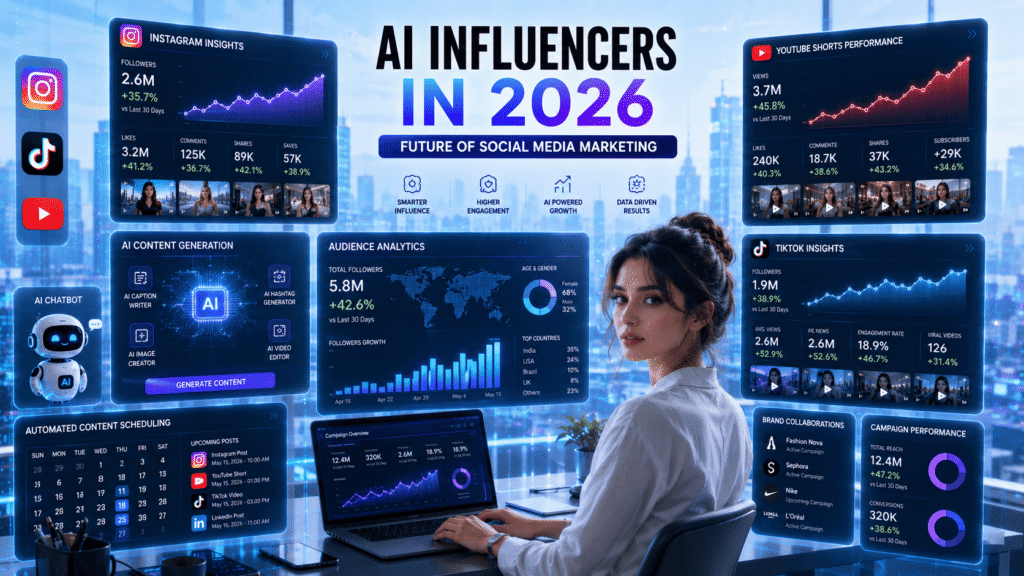
How Brands Are Using AI Influencers in 2026: Complete Future Marketing Guide
How Brands Are Using AI Influencers in 2026: Powerful Future Marketing Guide
Introduction
Artificial intelligence is transforming the entire digital marketing industry in 2026. One of the biggest changes happening right now is the rise of AI influencers.
Brands, agencies, startups, ecommerce companies, and social media marketers are increasingly using AI influencers to grow audiences, automate branding campaigns, improve engagement, and create scalable content systems.
Traditional influencer marketing is still growing, but AI-generated influencers are introducing an entirely new era of digital branding.
Virtual creators powered by artificial intelligence are now appearing across:
- TikTok
- YouTube
- fashion campaigns
- ecommerce advertising
- AI-generated brand collaborations
Many businesses are asking important questions:
- What are AI influencers?
- Why are brands investing in virtual influencers?
- Can AI influencers replace human creators?
- How do AI influencer campaigns work?
- What is the future of AI influencer marketing?
In this complete guide, you will learn:
- how AI influencers work,
- why brands are using them,
- advantages and risks,
- future digital marketing trends,
- AI branding strategies,
- virtual creator growth,
- and how businesses can use AI influencers successfully in 2026.
What Are AI Influencers?
AI influencers are computer-generated virtual personalities powered by artificial intelligence, 3D design systems, machine learning, and advanced content automation.
These digital creators behave similarly to human influencers.
They can:
- post social media content,
- promote products,
- interact with followers,
- collaborate with brands,
- create videos,
- generate captions,
- participate in campaigns.
Some AI influencers look extremely realistic while others are designed with stylized or animated appearances.
Unlike traditional influencers, AI influencers are completely controlled by:
- creative teams,
- AI systems,
- marketing agencies,
- brand strategy departments.
This gives companies much more control over branding consistency.
Why AI Influencers Are Growing Rapidly in 2026
AI influencer marketing is growing rapidly because social media itself is becoming increasingly AI-driven.
Platforms now prioritize:
- personalized content,
- AI recommendations,
- virtual experiences,
- digital entertainment,
- creator economy systems.
At the same time, brands are searching for scalable ways to produce high-quality content without relying entirely on human creators.
AI influencers help businesses:
- reduce production limitations,
- maintain branding consistency,
- automate campaigns,
- create 24/7 content systems,
- scale influencer marketing globally.
This makes virtual influencers extremely attractive for many companies.
How AI Influencers Work
AI influencers combine multiple technologies together.
These include:
- artificial intelligence,
- CGI technology,
- machine learning,
- natural language processing,
- AI image generation,
- voice synthesis,
- automation systems.
Creative teams build detailed digital personalities around these virtual influencers.
This includes:
- personality traits,
- interests,
- communication style,
- fashion preferences,
- audience demographics,
- storytelling themes.
AI systems then help automate:
- captions,
- content generation,
- interactions,
- audience engagement,
- campaign workflows.
Major Brands Using AI Influencers in 2026
Many global brands are already experimenting with AI influencer campaigns.
Industries adopting virtual influencer marketing include:
- fashion,
- beauty,
- gaming,
- technology,
- ecommerce,
- luxury branding,
- entertainment.
Brands are using AI influencers because:
- campaigns are easier to control,
- branding remains consistent,
- content production becomes scalable,
- AI creators never face scheduling issues.
Some companies even create their own in-house AI influencer personalities.
This allows brands to build long-term digital ecosystems around virtual creators.
AI Influencers vs Human Influencers
One of the biggest debates in digital marketing is whether AI influencers can replace human influencers.
The answer is more complex.
Advantages of Human Influencers
Human influencers provide:
- emotional authenticity,
- personal experiences,
- real storytelling,
- stronger human relatability.
Audiences still connect deeply with genuine human experiences.
Advantages of AI Influencers
AI influencers provide:
- branding consistency,
- unlimited scalability,
- lower long-term production costs,
- controlled messaging,
- continuous content creation.
Most experts believe the future will involve a combination of both.
Benefits of AI Influencer Marketing
Branding Consistency
AI influencers always follow the exact branding strategy created by companies.
This reduces unpredictable controversies.
24/7 Content Production
AI creators can continuously generate:
- images,
- videos,
- captions,
- campaigns,
- product promotions.
Global Scalability
Virtual influencers can operate in multiple languages and markets.
Cost Efficiency
Large brands can reduce some traditional influencer production costs.
AI Personalization
AI systems can personalize campaigns based on:
- audience behavior,
- demographics,
- interests,
- engagement patterns.
Risks and Challenges of AI Influencers
Despite rapid growth, AI influencer marketing also faces major challenges.
Authenticity Concerns
Some audiences dislike overly artificial content.
People still value:
- genuine experiences,
- emotional storytelling,
- human authenticity.
Ethical Questions
AI-generated personalities raise concerns around:
- transparency,
- manipulation,
- digital identity,
- misinformation.
Audience Trust
Brands must clearly communicate when influencers are AI-generated.
Trust remains extremely important in modern marketing.
AI Influencers on Instagram
Instagram is currently one of the biggest platforms for AI influencers.
Virtual creators post:
- fashion content,
- lifestyle photos,
- brand promotions,
- AI-generated campaigns,
- short-form Reels.
Instagram’s visual-first ecosystem works extremely well for virtual influencers.
AI-generated visuals can now look highly realistic because of advanced image-generation technology.
AI Influencers on TikTok
TikTok’s algorithm rewards:
- entertaining content,
- high retention,
- viral storytelling,
- trend participation.
This creates strong opportunities for AI influencers.
Brands use virtual creators on TikTok for:
- trend-based marketing,
- short-form campaigns,
- viral engagement,
- AI-generated storytelling.
AI Influencers on YouTube
YouTube is also evolving rapidly with AI-generated creators.
AI influencers can now appear in:
- animated videos,
- virtual podcasts,
- educational content,
- gaming content,
- AI-generated entertainment.
YouTube’s search visibility creates long-term discoverability opportunities.
AI Influencers and the Creator Economy
The creator economy is becoming increasingly AI-powered.
AI systems now help creators:
- edit videos,
- generate thumbnails,
- optimize captions,
- automate scheduling,
- analyze analytics.
Virtual creators are becoming another extension of this evolution.
Brands are investing heavily in creator ecosystems because audience attention is shifting away from traditional advertising.
AI Influencer Marketing Strategies for Brands
Build a Strong Brand Personality
AI influencers need:
- consistent storytelling,
- clear audience identity,
- visual branding,
- emotional positioning.
Focus on Storytelling
The best AI influencer campaigns use narrative-driven marketing instead of simple advertisements.
Use Multi-Platform Distribution
Brands should repurpose content across:
- Instagram,
- TikTok,
- YouTube Shorts,
- LinkedIn,
- Pinterest.
Combine Human + AI Content
Hybrid marketing systems often perform best.
Future Trends in AI Influencer Marketing
Several major trends are shaping the future of AI influencers in 2026.
Hyper-Realistic AI Creators
AI-generated personalities are becoming increasingly realistic.
AI Voice Generation
AI influencers can now create voice-based content.
Virtual Shopping Experiences
AI influencers are increasingly connected to ecommerce.
AI Livestreaming
Future systems may allow fully interactive AI livestream influencers.
Personalized Influencer Experiences
AI systems may personalize influencer content for individual users.
The Role of AI in Social Media Marketing
AI is not only influencing creators.
It is transforming the entire social media ecosystem.
Platforms now use AI for:
- recommendation systems,
- audience targeting,
- moderation,
- engagement prediction,
- personalization.
Brands that understand these AI systems can improve visibility significantly.
How Small Businesses Can Use AI Influencers
AI influencer marketing is not limited to large corporations.
Small businesses can:
- create AI brand mascots,
- generate virtual spokespersons,
- automate content campaigns,
- improve branding consistency.
AI tools are becoming increasingly accessible.
Common Mistakes Brands Make
Overusing Automation
Too much automation reduces authenticity.
Ignoring Audience Trust
Transparency is critical.
Weak Storytelling
Even AI influencers require strong narratives.
Low-Quality Visuals
Professional design remains extremely important.
The Future of Human Influencers
Human influencers are not disappearing.
Instead, influencer marketing is evolving into hybrid systems.
Future creators may combine:
- AI-generated workflows,
- human creativity,
- virtual branding,
- personalized audience experiences.
The future of influencer marketing will likely include both human and AI creators together.
FAQ Section
What are AI influencers?
AI influencers are virtual digital personalities powered by artificial intelligence and CGI technologies.
Why are brands using AI influencers?
Brands use AI influencers for scalable content creation, branding consistency, automation, and audience engagement.
Can AI influencers replace humans?
AI influencers may support marketing systems, but human influencers still provide stronger emotional authenticity.
Are AI influencers profitable?
Yes. Many brands are investing heavily in virtual influencer campaigns because of scalability and engagement potential.
What industries use AI influencers?
Fashion, beauty, gaming, technology, entertainment, and ecommerce industries are actively experimenting with AI influencer marketing.
Final Conclusion
AI influencer marketing is becoming one of the most important digital marketing trends in 2026.
Brands are increasingly using AI influencers to:
- automate campaigns,
- improve scalability,
- maintain branding consistency,
- create futuristic digital experiences.
At the same time, authenticity and trust remain critical.
The future of influencer marketing will likely involve a combination of:
- human creators,
- AI-generated influencers,
- hybrid content systems,
- personalized AI-driven experiences.
Businesses that adapt early to AI influencer marketing strategies will gain strong competitive advantages in future digital ecosystems.
As artificial intelligence continues evolving, virtual creators may become one of the biggest forces shaping the future of social media marketing.