Blog

Your blog category

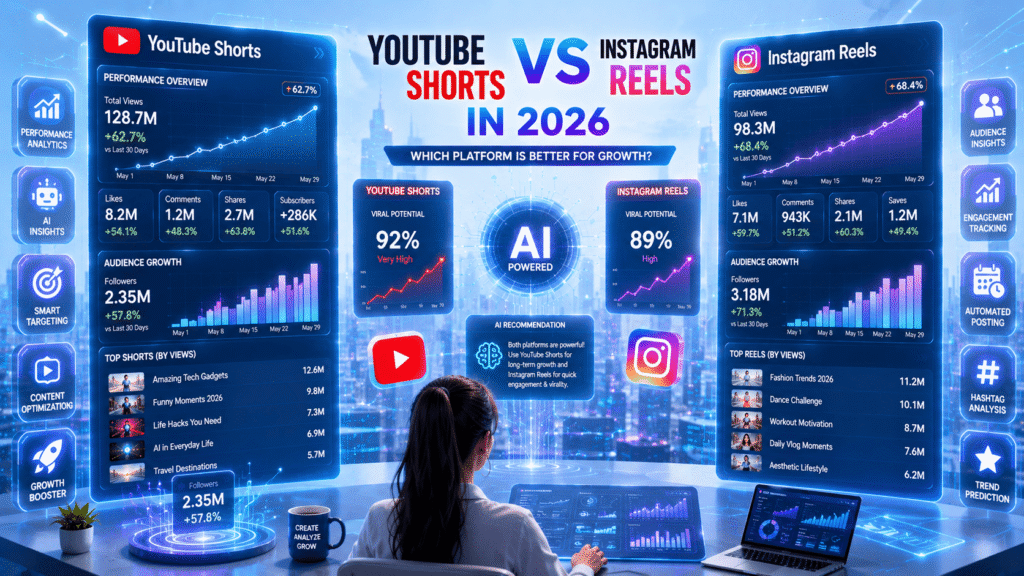
YouTube Shorts vs Instagram Reels

YouTube Shorts vs Instagram Reels in 2026: Which Gives Faster Growth?

YouTube Shorts vs Instagram Reels in 2026: Which Gives Faster Growth? Introduction The battle between YouTube Shorts and Instagram Reels is becoming more competitive in 2026. Content creators, influencers, brands, and digital marketers are constantly searching for the best platform to achieve faster audience growth, higher engagement, and stronger monetization opportunities. Short-form video content has completely transformed social media marketing. Platforms are prioritizing vertical video content because users now prefer fast, engaging, and personalized entertainment experiences. As AI-powered algorithms continue evolving, creators must understand which platform offers better organic reach, better discoverability, and stronger long-term growth potential. Many creators ask an important question: should they focus on YouTube Shorts or Instagram Reels in 2026? The answer depends on several factors including audience behavior, niche selection, content style, consistency, monetization goals, and algorithm optimization. Both platforms offer unique advantages, but they work differently behind the scenes. In this complete guide, we will compare YouTube Shorts vs Instagram Reels based on: By the end of this article, you will clearly understand which platform is better for creators, influencers, businesses, and brands in 2026. Why Short-Form Video Content Dominates Social Media in 2026 Short-form video marketing is now the center of digital marketing strategies. Social media platforms are heavily investing in AI-driven video recommendation systems to keep users engaged for longer periods. Modern audiences prefer: This behavior has made YouTube Shorts and Instagram Reels extremely powerful growth channels. Businesses are also shifting their marketing budgets toward short-form content because: As a result, creators who understand short-form video optimization can build massive audiences much faster than traditional blogging or long-form content alone. Understanding YouTube Shorts in 2026 YouTube Shorts is YouTube’s short-form vertical video platform designed to compete with TikTok and Instagram Reels. In 2026, YouTube Shorts has evolved significantly due to: One major advantage of YouTube Shorts is its connection to the YouTube ecosystem. Unlike many social platforms, YouTube acts as both: This gives creators long-term visibility advantages. Key Features of YouTube Shorts AI-Based Content Recommendations YouTube uses advanced machine learning algorithms to recommend Shorts based on: Strong Search Visibility YouTube Shorts can appear in: This creates long-term traffic opportunities. Long Content Lifespan Unlike Instagram Reels, YouTube Shorts can continue gaining views for months. Better Monetization Creators now earn through: Understanding Instagram Reels in 2026 Instagram Reels remains one of the most powerful tools for audience engagement and brand visibility. Meta is heavily prioritizing: Instagram Reels works exceptionally well for: Key Features of Instagram Reels Viral Discovery Instagram Reels can go viral very quickly due to: Strong Community Building Instagram creates stronger audience relationships through: Brand Collaboration Opportunities Many brands still prefer Instagram influencers for: Faster Initial Reach Instagram Reels often generates immediate visibility faster than YouTube Shorts. YouTube Shorts vs Instagram Reels: Organic Reach Comparison Organic reach is one of the most important ranking factors for creators. YouTube Shorts Organic Reach Advantages: Disadvantages: Instagram Reels Organic Reach Advantages: Disadvantages: Winner for Organic Reach in 2026 For long-term discoverability: For instant virality: Engagement Comparison Engagement determines how algorithms distribute content. Instagram Reels Engagement Instagram encourages: This creates very strong engagement signals. YouTube Shorts Engagement YouTube focuses more on: Which Platform Gives Faster Growth? This is the biggest question creators ask. YouTube Shorts Growth Pattern Growth on YouTube Shorts is: A Short can suddenly gain views months later. Instagram Reels Growth Pattern Instagram growth is: Most Reels lose momentum quickly after posting. Monetization Comparison YouTube Shorts Monetization YouTube provides: Creators can scale income more effectively. Instagram Reels Monetization Instagram monetization depends more on: Best Platform for Beginners Choose YouTube Shorts If: Choose Instagram Reels If: AI Algorithms in 2026 AI is transforming social media marketing. Both platforms now use: Creators must now optimize for: Keyword stuffing no longer works effectively. Best Content Strategy for 2026 The smartest creators now use both platforms together. Recommended Strategy Upload: Repurpose Content: One video can be optimized differently for each platform. Build Cross-Platform Authority: Creators with multi-platform visibility grow faster. Common Mistakes Creators Make Mistake 1: Posting Random Content Consistency matters more than random uploads. Mistake 2: Ignoring Analytics Data helps improve: Mistake 3: Weak Hooks The first 3 seconds determine success. Mistake 4: Low Video Quality Professional editing improves trust and retention. Future of Short-Form Content In 2026 and beyond: Creators who adapt early will gain the biggest advantage. Final Verdict: YouTube Shorts vs Instagram Reels in 2026 Both platforms are extremely powerful. YouTube Shorts is better for: Instagram Reels is better for: The best strategy for creators and businesses in 2026 is using both platforms together strategically. Short-form video content is no longer optional. It is now one of the strongest growth channels in digital marketing. Creators who understand AI-driven algorithms, audience psychology, and platform-specific optimization will dominate social media growth in 2026. YouTube Official Blog Instagram Official Updates Google AI Search SEO Guide Zero Click SEO in 2026

YouTube Shorts vs Instagram Reels in 2026: Which Gives Faster Growth? Read More »
social media marketing in 2026

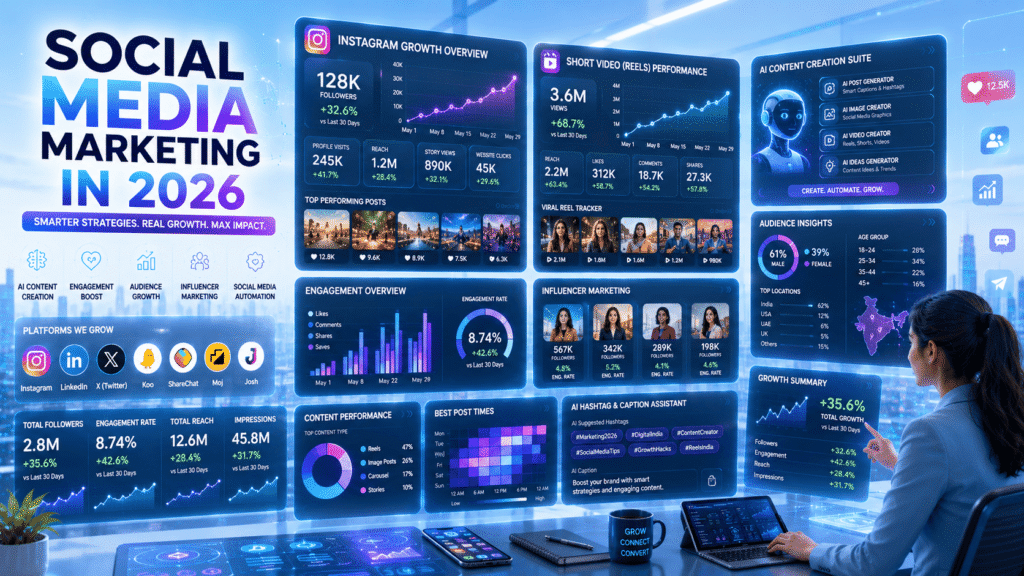
Social Media Marketing in 2026: Powerful AI Growth Strategy for Brands

Social Media Marketing in 2026: Powerful AI Growth Strategy for Brands Introduction Social media marketing in 2026 is evolving faster than ever before. Traditional posting methods are no longer enough for brands that want to grow online visibility, increase audience engagement, and build long-term authority. Artificial intelligence, changing social media algorithms, short-form video dominance, and AI-powered content creation are completely transforming digital marketing strategies. Businesses that adapt to modern social media marketing trends early are growing significantly faster than competitors that still rely on outdated strategies. Platforms like Instagram, YouTube, Facebook, LinkedIn, Pinterest, and TikTok are prioritizing engagement quality, watch time, audience retention, and semantic content relevance. This means brands must now focus on audience psychology, AI-assisted creativity, storytelling, and value-driven content instead of simply posting promotional material. In this complete guide, you will learn how social media marketing in 2026 works, what strategies are driving growth, and how businesses can build powerful AI-driven marketing systems for long-term success. Why Social Media Marketing Is Changing in 2026 The social media landscape is becoming increasingly competitive. Millions of businesses are creating content every day, making organic visibility more difficult than before. At the same time, social media platforms are improving AI systems that analyze: This shift means low-quality repetitive content is losing visibility. Modern platforms now reward: Brands that understand these changes are growing significantly faster. The Rise of AI Social Media Marketing AI social media marketing is one of the biggest digital marketing trends in 2026. Artificial intelligence tools are helping brands: However, businesses that simply rely on AI-generated content without adding originality are struggling. The best-performing brands combine: This balance creates stronger audience trust and engagement. Instagram Marketing Strategy in 2026 Instagram remains one of the most powerful social media platforms for brands. But Instagram marketing in 2026 is very different from previous years. The Instagram algorithm now heavily prioritizes: Static image posts alone are no longer enough. Brands that want organic Instagram growth must focus on: Short-Form Video Content Short-form vertical videos dominate Instagram engagement. High-performing Reels usually: Educational Content Educational content performs extremely well because users save and share useful posts. Examples include: Personal Branding People trust people more than logos. Brands using personal branding strategies are building stronger communities and better engagement. Showing: helps build authenticity. TikTok Marketing in 2026 TikTok continues influencing global digital culture. TikTok marketing strategies are now heavily influencing Instagram Reels and YouTube Shorts. TikTok’s algorithm is still one of the strongest discovery systems online. It prioritizes: Brands succeeding on TikTok focus on: Instead of highly polished advertisements, users prefer natural and relatable videos. AI Content Creation for Social Media AI content creation tools are helping marketers produce content faster. Popular AI workflows now include: However, AI-generated content without strategy usually performs poorly. The best results happen when brands combine: This creates scalable but authentic content systems. Future Social Media Trends in 2026 Several major trends are shaping social media marketing in 2026. AI-Powered Search Inside Social Platforms Social platforms are becoming search engines. Users now search Instagram, TikTok, and YouTube for: This means social media SEO is becoming extremely important. Community-Based Marketing Communities are becoming more valuable than large follower counts. Brands focusing on strong audience relationships are building better long-term engagement. Short Attention Spans Content must capture attention immediately. The first 3 seconds are now critical. Multi-Platform Content Systems Modern brands repurpose content across: This improves efficiency and visibility. Social Media SEO in 2026 Social media SEO is becoming increasingly important. Platforms now analyze: Brands should optimize: This helps content appear in platform search results. Organic Growth vs Paid Advertising Paid advertising still works, but organic branding is becoming more valuable. Organic growth builds: Paid ads work best when combined with strong organic content. Businesses relying only on paid ads often struggle with increasing advertising costs. Influencer Marketing in 2026 Influencer marketing continues growing. However, authenticity is now more important than follower count. Micro-influencers often outperform large creators because they have: Brands are increasingly focusing on long-term creator partnerships instead of one-time promotions. The Importance of Storytelling Storytelling is becoming one of the most powerful marketing tools. Users are overwhelmed with content. Stories help brands create emotional connections. Effective storytelling includes: This improves engagement and audience retention. AI Automation for Social Media Management AI automation tools are simplifying workflow management. Brands now automate: Automation saves time while improving consistency. However, over-automation can reduce authenticity. The best strategy combines automation with human creativity. Content Consistency and Posting Frequency Consistency remains extremely important. Most successful brands follow structured content calendars. Posting consistently helps: Quality remains more important than quantity. Video Marketing Dominance Video marketing dominates almost every social platform. High-performing videos usually: Brands ignoring video marketing are losing significant reach opportunities. Common Social Media Marketing Mistakes Many businesses still make major mistakes. Posting Without Strategy Random posting creates inconsistent branding. Ignoring Analytics Analytics help businesses understand: Copying Competitors Successful brands create unique positioning instead of blindly copying trends. Focusing Only on Followers Engagement quality matters more than follower count. How Businesses Can Build Strong Social Media Authority Authority-building strategies include: Authority improves both engagement and trust. The Future of Digital Marketing Beyond 2026 Digital marketing will continue becoming increasingly AI-driven. Future trends may include: Brands that adapt early will gain major competitive advantages. Final Thoughts Social media marketing in 2026 is no longer simply about posting content. Modern brands must understand AI systems, audience psychology, storytelling, semantic SEO, and platform algorithms. Businesses that combine creativity, authenticity, and AI-powered efficiency are building stronger long-term growth systems. The future belongs to brands that create valuable content, build genuine communities, and adapt quickly to digital transformation. As AI continues changing digital marketing, businesses that focus on trust, engagement, and strategic innovation will dominate the future of social media growth. Why Social Media Marketing in 2026 Is More Competitive Social media marketing in 2026 is becoming more competitive because businesses are using AI tools, automation systems, and advanced audience targeting strategies. Brands that understand social

Social Media Marketing in 2026: Powerful AI Growth Strategy for Brands Read More »

how to rank in Google AI search

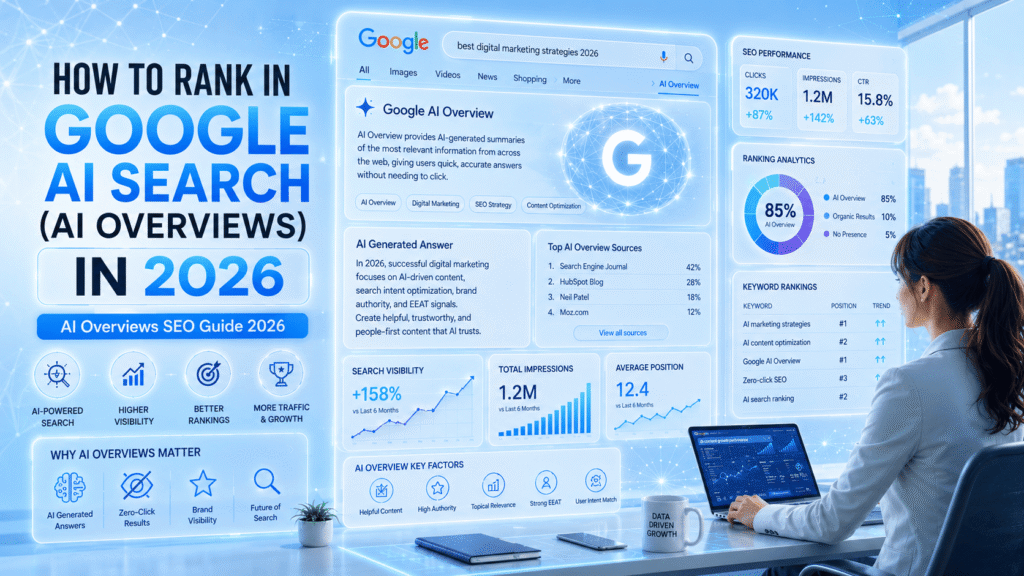
How to Rank in Google AI Search (AI Overviews) in 2026: Complete Practical Guide

How to Rank in Google AI Search (AI Overviews) in 2026: Complete Practical Guide Introduction: SEO Has Changed Faster Than Most Businesses Expected Businesses now want to understand how to rank in Google AI search because traditional SEO strategies alone are no longer enough in 2026. you are still focusing only on traditional Google rankings, then you are already behind in 2026. The biggest shift happening in search right now is not just algorithm updates. It is the rise of AI-powered search systems. Google AI Overviews are changing how users interact with search results. Instead of browsing multiple websites, users are now receiving AI-generated answers instantly. This has created a completely new challenge for businesses and SEO professionals. Many websites are seeing: At first, many businesses thought their SEO strategy was failing. But after analyzing modern search behavior closely, the real reason became clear: Google is becoming an answer engine, not only a search engine. This means ranking on Google is no longer enough. Now businesses must optimize for AI visibility. The goal in 2026 is not only to rank. The goal is to become part of Google AI answers. What is Google AI Search? Google AI Search refers to Google’s AI-powered search experience that generates summarized answers directly inside search results. This includes: Instead of showing only blue links, Google now analyzes multiple sources and creates AI-generated responses for users. This changes how users interact with websites and search engines. Businesses that understand how to rank in Google AI search early will have a much stronger chance of gaining visibility in future AI-powered search systems. What Are Google AI Overviews? Google AI Overviews are AI-generated summaries displayed at the top of search results. These summaries combine information from multiple websites to answer user questions instantly. For many informational searches, users no longer need to open websites because Google already provides the answer. This is one of the biggest changes in modern SEO. Understanding how to rank in Google AI search requires businesses to focus on topical authority, semantic SEO, and AI-friendly content structure. Why Google Created AI Overviews Google introduced AI Overviews because user behavior changed dramatically. Users Want Faster Answers Modern users prefer instant answers instead of browsing many websites. AI Competition Increased Platforms like ChatGPT, Gemini, and Perplexity changed how people search for information. Search Became More Conversational Users now ask complete questions instead of typing short keywords. Google adapted by becoming more AI-driven. Why Businesses Are Losing Traffic After AI Search This is one of the most important topics businesses need to understand. Many companies are seeing traffic decline even while rankings remain stable. This happens because users are getting answers directly inside Google AI Overviews. In many SEO projects, we observed: This clearly shows that rankings and clicks are no longer directly connected. Visibility now works differently. How Google AI Search Actually Works 1. Query Understanding Google AI first analyzes the user’s intent and question context. 2. Information Retrieval Google collects information from multiple relevant sources. 3. Content Evaluation AI systems evaluate: 4. AI Summary Generation Google combines information into one summarized answer. This means your content becomes part of a larger AI-generated response. Why Traditional SEO Alone Is No Longer Enough Traditional SEO focused heavily on: These things still matter. But now AI systems also evaluate: This is why modern SEO requires a different strategy. The Biggest Shift in SEO: Visibility Over Clicks One of the biggest mistakes businesses make is focusing only on traffic. Modern SEO success also includes: In AI search environments, visibility itself becomes valuable. How to Rank in Google AI Search in 2026 1. Build Topical Authority Google AI strongly prefers websites that deeply cover a topic. This means you should create connected content clusters instead of isolated blogs. For example: This signals expertise to AI systems. 2. Use Question-Based Headings AI systems heavily prefer question-based content. Examples: This improves answer extraction. 3. Give Direct Answers First Start sections with concise answers before detailed explanations. This increases your chances of appearing in AI summaries. 4. Improve Content Structure Well-structured content is easier for AI systems to understand. Use: 5. Focus on Semantic SEO Modern SEO is no longer only about exact keywords. Google AI understands: This is why semantic keyword coverage matters. 6. Add Real Expertise Generic AI-generated content is everywhere. What stands out now is: This improves trust and authority. How AI Systems Choose Websites Google AI does not randomly select websites. It evaluates: Businesses that consistently publish valuable content gain stronger AI visibility over time. Why Human Experience Matters More Than Ever One of the biggest misconceptions in modern SEO is that AI can fully replace human expertise. That is completely wrong. AI can generate content quickly, but it often lacks: Google increasingly values: This is why expert-driven content performs better long-term. Common AI SEO Mistakes Businesses Make These mistakes reduce AI visibility. How Small Businesses Can Compete in AI Search Small businesses can still compete effectively if they focus on: AI search rewards expertise more than company size. Future of SEO After Google AI Search The future of SEO is becoming more connected with AI systems. Modern SEO will combine: Businesses that adapt early will gain long-term advantages. FAQ Section What is Google AI Search? Google AI Search uses artificial intelligence to generate direct answers inside search results. What are Google AI Overviews? AI Overviews are AI-generated summaries shown at the top of search results. How do I rank in Google AI Search? You can improve AI visibility by building authority, creating structured content, and optimizing for AI understanding. Is traditional SEO dead? No. Traditional SEO still matters, but AI optimization is now equally important. Why is my website traffic dropping? AI Overviews and zero-click searches reduce the need for users to click websites .The businesses that learn how to rank in Google AI search early will gain a major visibility advantage in future AI-powered search results. Learning how to rank in Google AI search is

How to Rank in Google AI Search (AI Overviews) in 2026: Complete Practical Guide Read More »

Google AI Overviews

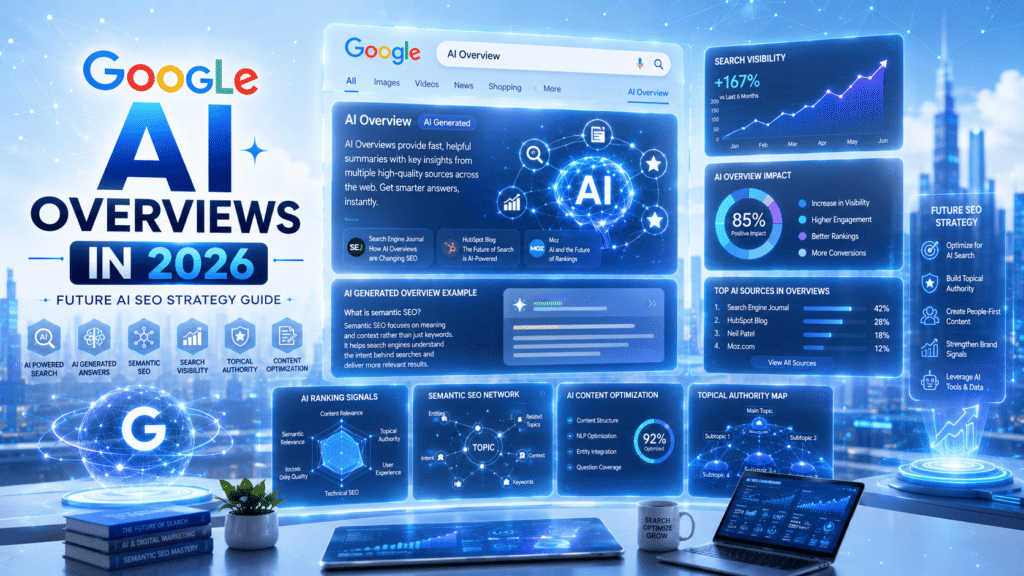
How Businesses Can Rank in Google AI Overviews in 2026: Complete AI SEO Strategy Guide

How Businesses Can Rank in Google AI Overviews in 2026: Complete AI SEO Strategy Guide Search engine optimization is changing faster than most businesses expected. For years, traditional SEO focused on ranking websites on the first page of Google search results. Businesses optimized blog posts, built backlinks, improved keyword density, and tried to increase organic traffic. But in 2026, Google AI Overviews are completely changing how users interact with search engines. Instead of simply showing blue links, Google now provides AI-generated answers directly inside search results. Users can instantly receive summarized information without clicking multiple websites. This shift is creating a massive transformation in digital marketing. Businesses that understand Google AI Overviews early are gaining authority, visibility, and long-term traffic advantages. Meanwhile, websites relying only on old SEO methods are slowly losing clicks and organic reach. The future of SEO is no longer only about ranking webpages. It is now about becoming a trusted source that Google’s AI systems use for generating answers. That is why understanding Google AI Overviews in 2026 has become one of the most important skills in modern digital marketing. What Are Google AI Overviews? Google AI Overviews are AI-generated summaries displayed directly inside Google search results. Instead of forcing users to open multiple websites, Google’s artificial intelligence analyzes content from trusted sources and creates detailed instant answers. These AI-generated summaries usually appear at the top of search results and contain: Google AI Overviews are powered by advanced AI systems that understand user intent, semantic meaning, topical authority, and search behavior patterns. This means websites now need stronger content quality, deeper topical relevance, and better semantic SEO optimization than ever before. Why Google AI Overviews Matter for Businesses Google AI Overviews are changing search visibility across almost every industry. Businesses that successfully optimize for AI-powered search systems can achieve: Modern search engines are prioritizing expertise, credibility, user experience, and contextual understanding. This means businesses must move beyond outdated SEO tricks and focus on genuinely valuable content. How AI Search Is Changing Traditional SEO Traditional SEO depended heavily on exact-match keywords and backlinks. But AI-powered search systems now analyze: Google AI Overviews prioritize websites that demonstrate real expertise and helpful information. This is why businesses need to build topical authority instead of publishing thin keyword-focused articles. Semantic SEO Will Dominate in 2026 Semantic SEO has become one of the most powerful ranking factors in AI-generated search systems. Instead of repeating one keyword unnaturally, semantic SEO focuses on topic relationships and contextual understanding. For example, an article about Google AI Overviews should naturally include related concepts like: This helps search engines understand the complete meaning of your content. How Businesses Can Optimize for Google AI Overviews Create High-Authority Content Google AI systems prefer trustworthy and detailed content. Businesses should create comprehensive guides that solve real user problems instead of publishing shallow AI-generated articles. Focus on User Intent Every search query has a purpose. Some users want information, while others want comparisons, tutorials, or buying recommendations. Your content must directly satisfy that intent. Use Structured Headings Well-organized content improves readability for both users and AI systems. Use proper heading structures like: Improve Topical Authority Publishing multiple connected articles around one topic helps Google trust your website more. This is why creating complete topic clusters is extremely important in 2026 SEO. The Importance of EEAT in AI SEO Google continues prioritizing EEAT: Businesses that demonstrate real expertise have better chances of appearing inside Google AI Overviews. Future of SEO Beyond 2026 The future of SEO will become even more AI-driven. Search engines are evolving into intelligent answer systems rather than simple search result directories. Businesses must adapt quickly by focusing on: Final Thoughts Google AI Overviews are not a temporary trend. They represent the future of digital search. Businesses that adapt early to AI-powered search systems will gain major long-term advantages in visibility, authority, and organic growth. Instead of relying on outdated SEO methods, modern businesses must build semantic relevance, trust, expertise, and user-focused content strategies. The brands that understand AI SEO optimization today will become the dominant search leaders of tomorrow. According to Google Search documentation, helpful and people-first content is one of the most important ranking factors for Google AI Overviews in 2026. If you want to understand modern AI search optimization deeply, also read our complete guide on How to Rank in Google AI Search.  

How Businesses Can Rank in Google AI Overviews in 2026: Complete AI SEO Strategy Guide Read More »

AI SEO strategy in 2026

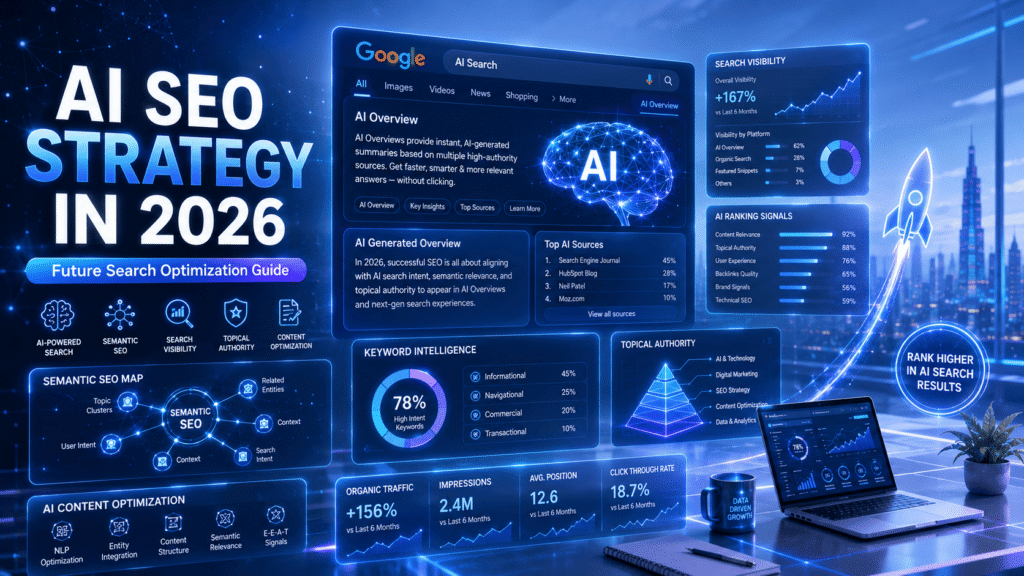
AI SEO Strategy in 2026: Complete Future Search Optimization Guide

AI SEO Strategy in 2026: Powerful Future Search Optimization Guide AI SEO strategy in 2026 is changing digital marketing faster than most businesses expected. Traditional SEO techniques are no longer enough because Google AI Search and AI-generated search experiences are transforming how users discover information online. Modern search engines are becoming smarter through artificial intelligence systems. Instead of showing only traditional blue links, Google increasingly provides AI-generated answers directly inside search results. This shift is completely changing how businesses approach SEO. Companies that adapt early to future AI-powered search systems can build stronger visibility, authority, and long-term organic growth. In this complete guide, you will learn how the AI SEO strategy in 2026 works, why semantic SEO matters, how Google AI Overviews affect rankings, and what businesses should do to improve future search visibility. Why Traditional SEO Is Rapidly Changing For many years, businesses mainly focused on backlinks, keyword optimization, and technical SEO improvements. Those methods still matter today, but AI-powered search systems are changing the SEO industry rapidly. Google increasingly understands user intent, semantic meaning, and contextual relationships much better than older search systems. This means businesses can no longer rely only on repetitive keyword optimization. Modern SEO now requires deeper topical authority, structured content, semantic optimization, and user-focused experiences. What Is AI SEO Strategy in 2026? AI SEO strategy in 2026 refers to modern optimization techniques designed specifically for AI-powered search systems. Instead of focusing only on traditional rankings, modern SEO now focuses on: Businesses now optimize content not only for human users but also for artificial intelligence systems that summarize and recommend information. How Google AI Search Is Transforming SEO Google AI Search is changing user behavior dramatically. Modern users increasingly ask conversational questions instead of typing short keywords. For example, users now search: Google AI systems analyze these questions contextually and provide more intelligent answers. This creates a major shift in modern SEO strategies. Why Semantic SEO Matters Semantic SEO helps search engines understand relationships between topics, meanings, and entities. Modern AI systems now evaluate context much more effectively than traditional keyword-based systems. For example, Google understands relationships between: Businesses that build strong semantic topic ecosystems often perform better in AI-powered search environments. How Topical Authority Improves Rankings Topical authority means becoming a trusted source about a specific subject. Instead of publishing random content, businesses should create connected content ecosystems. For example, an SEO agency website may publish: This helps search engines recognize expertise and authority more effectively. Why AI Readability Optimization Is Important AI readability optimization focuses on making content understandable for both users and AI systems. Businesses should avoid: Instead, businesses should create structured, natural, easy-to-read content. How Internal Linking Supports SEO Internal links help search engines understand relationships between pages across a website. For example: How to Rank in Google AI Search Internal links improve: Why External Sources Improve Trust Trusted external sources improve authority signals. For example: Google SEO Starter Guide Authoritative references support stronger trust and expertise signals. Conclusion AN AI SEO strategy in 2026 is becoming essential for modern digital marketing success. Businesses that adapt early to AI-powered search systems can improve long-term visibility, authority, and organic growth. Modern SEO now requires semantic optimization, topical authority, AI readability, and user-focused content strategies. Businesses that combine human expertise with modern AI SEO techniques can build stronger future search performance. How to Rank in Google AI Search Google SEO Starter Guide Google Search Blog Businesses that understand the AI SEO strategy in 2026 early can build stronger long-term search visibility. Modern search engines are increasingly using artificial intelligence to understand user intent, semantic relationships, topical authority, and content quality instead of depending only on traditional keyword-based ranking systems. Google AI Search is transforming how websites appear inside modern search results. Companies that improve semantic SEO, user experience, structured content, and AI-powered search optimization techniques can increase their chances of appearing in AI-generated search summaries and future search environments. AI Overviews SEO is becoming one of the most important parts of future digital marketing strategies. Businesses that publish detailed educational content, improve topical authority, and create natural semantic connections between articles often perform better in modern AI-powered search systems. Semantic SEO helps search engines understand the meaning behind content more accurately. Instead of repeating the same keywords unnaturally, businesses should focus on building useful, trustworthy, and easy-to-understand content ecosystems that support long-term organic growth.

AI SEO Strategy in 2026: Complete Future Search Optimization Guide Read More »

zero-click SEO in 2026

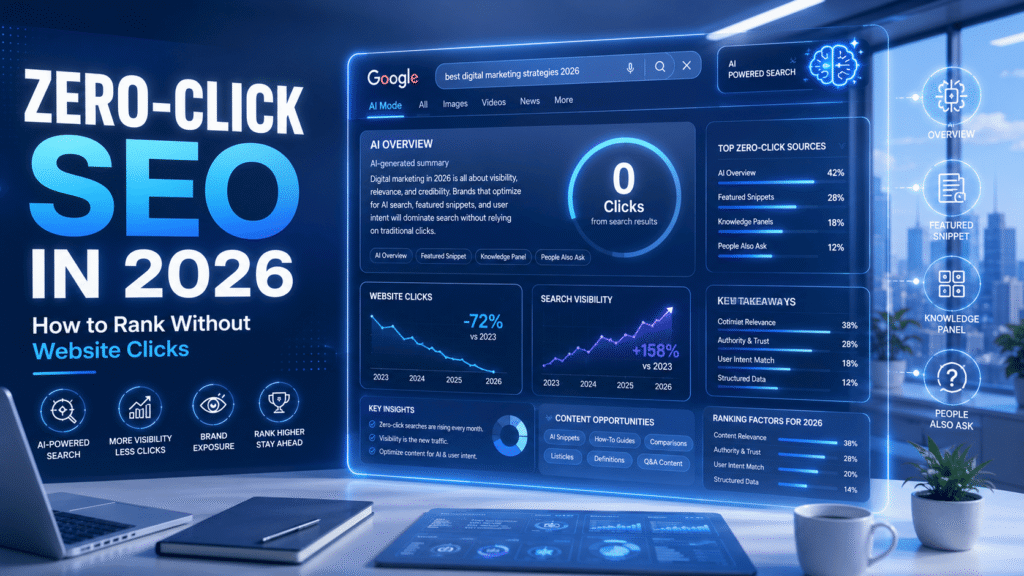
Zero-Click SEO in 2026: How Businesses Can Successfully Survive AI Search

Zero-Click SEO in 2026: How Businesses Successfully Survive AI Search Introduction: SEO Traffic Is Changing Faster Than Most Businesses Realize If your website traffic has suddenly started decreasing even though your rankings still appear stable, you are not alone. Thousands of businesses in 2026 are experiencing the same situation. Their technical SEO is healthy. Their pages are indexed. Their backlinks still exist. Their rankings may even look normal inside search results. But traffic continues to fall. For many businesses, this situation feels confusing at first. Most website owners immediately assume: However, after analyzing modern search behavior deeply, a completely different reality becomes clear. The biggest reason behind traffic decline in 2026 is not always rankings. The biggest reason is the rise of zero-click SEO in 2026 and AI-powered search experiences. Google is no longer behaving like a traditional search engine only. It is becoming an AI-powered answer engine. Users are increasingly receiving answers directly inside search results without clicking websites. This changes the entire SEO industry. And businesses that fail to adapt to this new AI search ecosystem may lose visibility, authority, and traffic over time. However, businesses that understand zero-click SEO in 2026 early can still build strong future growth opportunities. What Is Zero-Click SEO in 2026? Zero-click SEO refers to search experiences where users receive answers directly inside search results without needing to click on websites. Instead of opening multiple pages, users now often receive summarized AI-generated answers instantly. This happens through systems such as: As AI-powered search continues evolving, more informational searches are becoming zero-click searches. This means users may: This is one of the biggest SEO shifts happening right now. Why Zero-Click SEO in 2026 Is Growing Rapidly Google AI Overviews Changed Search Behavior The rise of Google AI Overviews dramatically changed how users interact with search engines. Previously, Google mainly displayed blue links that users clicked manually. Now Google increasingly generates AI-powered answers directly inside search results. This creates faster user experiences while reducing website clicks. As AI systems improve, Google becomes better at: This changes how businesses must think about SEO. Users Prefer Instant Information Modern users prefer fast information. Most users no longer want to open ten different pages to find one answer. They prefer: Google understands this behavior clearly. That is why AI-powered search systems continue expanding aggressively. Mobile Search Accelerated Zero-Click Behavior Mobile search behavior significantly increased zero-click searches. Mobile users usually want immediate answers with minimal scrolling. AI Overviews fit mobile behavior perfectly because they reduce search friction. This is one major reason why zero-click SEO in 2026 continues growing rapidly. Why Businesses Are Suddenly Losing Organic Traffic Many businesses built their entire marketing strategy around traditional organic traffic. For years, the SEO formula was relatively simple: However, AI-powered search disrupted this formula. Now businesses may still rank while receiving fewer clicks. This creates panic for many website owners. But traffic decline does not always mean SEO failure. Sometimes it simply means: This distinction is extremely important. Businesses that misunderstand this shift may make poor SEO decisions. Does Zero-Click SEO Mean SEO Is Dead? No. This is one of the biggest misconceptions spreading across the digital marketing industry. SEO is not dying. SEO is evolving. Traditional SEO focused heavily on: However, modern SEO increasingly focuses on: The businesses that adapt to this new AI ecosystem early will likely dominate future search visibility. The Biggest SEO Shift Happening Right Now One of the biggest changes happening in SEO today is that visibility matters more than clicks alone. Previously, SEO success was measured mainly through traffic volume. Today, businesses must also think about: Modern AI systems increasingly choose authoritative sources instead of simply ranking pages based only on keywords. This creates a major advantage for businesses building topical expertise early. How Businesses Can Survive Zero-Click SEO in 2026 1. Build Strong Topical Authority One of the most important strategies for surviving zero-click SEO in 2026 is building strong topical authority. Google AI systems prefer websites deeply focused on specific subjects. Businesses should stop publishing random disconnected blogs. Instead, they should create connected topic ecosystems. Example AI SEO topic cluster: This creates stronger semantic relevance and helps AI systems understand expertise depth. 2. Structure Content for AI Readability Modern AI systems strongly prefer content that is easy to scan and understand. Businesses that want stronger AI visibility should structure their content clearly. This includes using: AI-powered search systems analyze structure very carefully. Poorly formatted content becomes harder for AI systems to interpret and summarize. This is why modern SEO is no longer only about keywords. Structure itself became an SEO advantage. 3. Answer User Questions Directly One major difference between traditional SEO and AI-powered SEO is how answers are delivered. AI systems often extract direct answers from websites and display them immediately inside search results. This means businesses should clearly answer important user questions early inside their content. Examples include: Businesses that explain these questions clearly improve their chances of appearing inside AI-generated summaries. 4. Focus on Semantic SEO Instead of Only Keywords Older SEO strategies focused heavily on repeating exact keywords. Modern AI-powered search works differently. Google AI systems now understand: This means businesses should focus on complete topic coverage instead of excessive keyword repetition. For example, a strong article about zero-click SEO in 2026 should naturally discuss: This creates stronger contextual relevance. 5. Build Brand Authority and Trust Brand authority is becoming increasingly important in AI-powered search environments. Google AI systems prefer trustworthy sources. Businesses that consistently publish: are more likely to gain long-term AI visibility. This is why businesses should avoid: Human expertise matters more than ever before. Why Generic AI Blogs Often Fail One of the biggest problems happening online today is the explosion of low-quality AI-generated content. Many websites publish massive amounts of generic AI blogs hoping to gain quick traffic. However, this strategy often fails long term. Why? Because AI systems increasingly prioritize: Generic blogs usually: This is why businesses should focus on authority-level content instead

Zero-Click SEO in 2026: How Businesses Can Successfully Survive AI Search Read More »