Blog

Your blog category

website not appearing in AI search results

website not appearing in AI search results

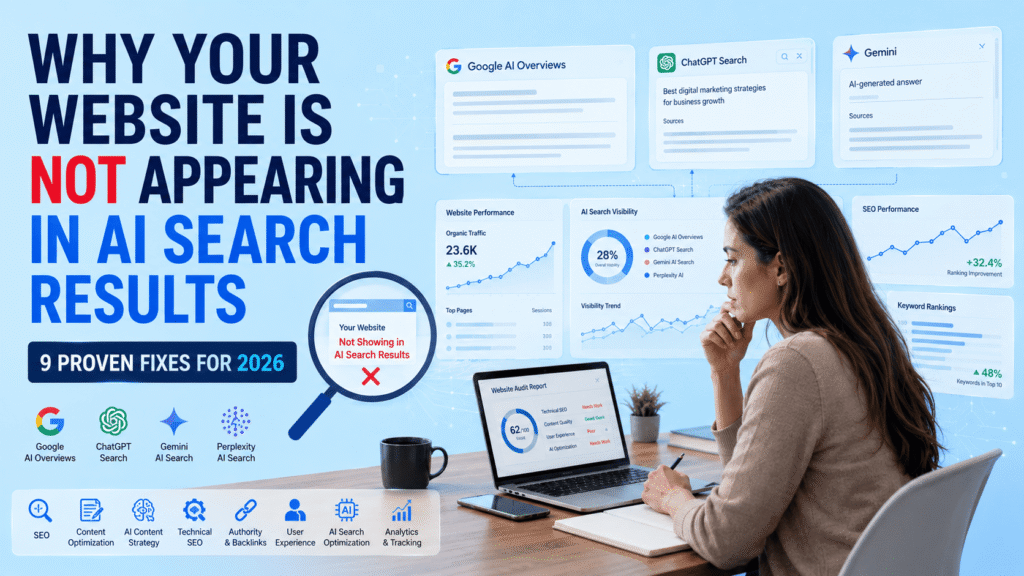
website not appearing in AI search results Introduction Have you noticed that your website ranks in Google Search but still doesn’t appear in Google AI Overviews, ChatGPT Search, Gemini, or Perplexity? You are not alone. Many businesses are discovering that traditional SEO alone is no longer enough. Search is evolving rapidly, and AI-powered search engines now choose which websites deserve visibility inside AI-generated answers. If your website is not appearing in AI search results, the problem is usually not a penalty. Instead, it is often related to content quality, authority, structured information, topical expertise, or lack of AI-friendly optimization. In this guide, you’ll learn exactly why websites fail to appear in AI search results and the practical steps you can take to improve your visibility across modern AI search platforms in 2026. “Website Not Appearing in AI Search Results” Mean? AI search engines do not work exactly like traditional search engines. Traditional Google Search displays a list of links. AI search systems such as: attempt to generate complete answers by analyzing multiple trusted sources. Instead of simply ranking pages, AI systems select content they believe is: If your content doesn’t meet these requirements, your website may never be referenced inside AI-generated answers. Why AI Search Visibility Matters in 2026 AI search is becoming a major source of online discovery. Benefits include: Businesses that adapt early will gain a significant advantage over competitors. 9 Reasons Your Website Is Not Appearing in AI Search Results 1. Your Content Lacks E-E-A-T Signals Google and AI systems evaluate: Solution 2. Your Content Is Too Generic AI engines prefer unique insights. Bad Example “What is SEO?” Better Example “How Local Businesses Can Use SEO to Generate Leads in 2026” Solution Create niche-specific content with original perspectives. 3. Your Website Has Weak Topical Authority Publishing random topics weakens authority. Solution Create topic clusters. Example: AI Search → GEO Optimization → AI Search Ranking Factors → ChatGPT Search SEO → Google AI Overview Optimization This strengthens topical relevance. 4. Lack of Structured Data AI systems rely heavily on structured information. Solution Implement: 5. Poor Content Structure AI models prefer organized content. Solution Use: This improves AI readability. 6. No Brand Authority Signals AI systems often favor recognized brands. Solution Build authority through: 7. Your Content Doesn’t Answer User Questions Clearly AI search engines prioritize direct answers. Solution Create question-based sections such as: 8. Weak Internal Linking Internal links help AI understand your website structure. Solution Connect related articles together using relevant anchor text. 9. Your Website Is Not Regularly Updated AI systems prefer fresh information. Solution Review and update important content every few months. Step-by-Step Guide to Improve AI Search Visibility Step 1: Audit Existing Content Identify: Step 2: Create Topic Clusters Focus on related subjects. Example: AI Search → GEO → AI SEO → ChatGPT Search → AI Overviews Step 3: Add Structured Data Implement schema markup to improve machine readability. Step 4: Build Authority Publish: Step 5: Improve Content Quality Every article should: Best Practices for AI Search Optimization Tools and Resources Useful tools include: Real-World Example Imagine a digital marketing agency publishing only service pages. AI systems may ignore the site. However, when the agency publishes: topical authority improves significantly. Over time, AI systems become more likely to reference that content in generated answers. Comparison Table Traditional SEO vs AI Search Optimization Traditional SEO: AI Search Optimization: Common Reasons Why Your Website Not Appearing in AI Search Results 1. Publishing Thin Content Impact:Low trust and visibility. Solution:Create comprehensive articles. 2. Ignoring E-E-A-T Impact:Reduced authority. Solution:Show expertise. 3. Overusing Keywords Impact:Poor readability. Solution:Write naturally. 4. No Internal Linking Impact:Weak topic connections. Solution:Build content clusters. 5. Not Using Schema Impact:Lower AI understanding. Solution:Implement structured data. 6. Outdated Content Impact:Reduced trust. Solution:Regular updates. 7. Chasing Algorithms Instead of Users Impact:Poor user experience. Solution:Focus on solving problems. Expert Tips Future Trends By 2026 and beyond: Why Your Website Not Appearing in AI Search Results: Final Expert Insights If you are still wondering why your website not appearing in AI search results, the answer usually comes down to authority, content quality, structured data, and AI optimization. Many businesses focus only on traditional SEO and ignore the factors that influence modern AI-powered search engines. One major reason why your website not appearing in AI search results is the lack of topical authority. AI platforms such as Google AI Overviews, ChatGPT Search, Gemini, and Perplexity prefer websites that consistently publish helpful, trustworthy, and experience-based content within a specific niche. Another reason why your website is not appearing in AI search results is poor content structure. AI systems can better understand content that uses clear headings, FAQs, schema markup, internal linking, and concise answers to user questions. If you want to solve the problem of why your website not appearing in AI search results, focus on creating expert-led content, improving website credibility, earning quality backlinks, and regularly updating older articles. These strategies help search engines and AI systems understand that your website is a reliable source of information. As AI search continues to evolve in 2026, businesses that adapt early will have a significant advantage. Understanding why your website is not appearing in AI search results is the first step toward improving visibility, increasing organic traffic, and building long-term authority online. Conclusion If your website is not appearing in AI search results, don’t panic. The issue is rarely technical. Most often, it relates to content quality, authority, structure, and topical relevance. Focus on creating helpful, trustworthy, and expert-driven content while strengthening your site’s authority through strategic SEO and GEO practices. Businesses that adapt to AI-powered search today will have a significant advantage in the future. FAQs Why is my website not appearing in Google AI Overviews? Usually because Google does not view the content as authoritative, trustworthy, or highly relevant for AI-generated answers. Does traditional SEO still matter for AI Search? Yes. Traditional SEO remains important, but AI search requires additional focus on E-E-A-T, topical authority, and content quality. What is

website not appearing in AI search results Read More »
AI Digital Marketing Roadmap

How Businesses Can Use AI for Digital Marketing in 2026: Complete Roadmap

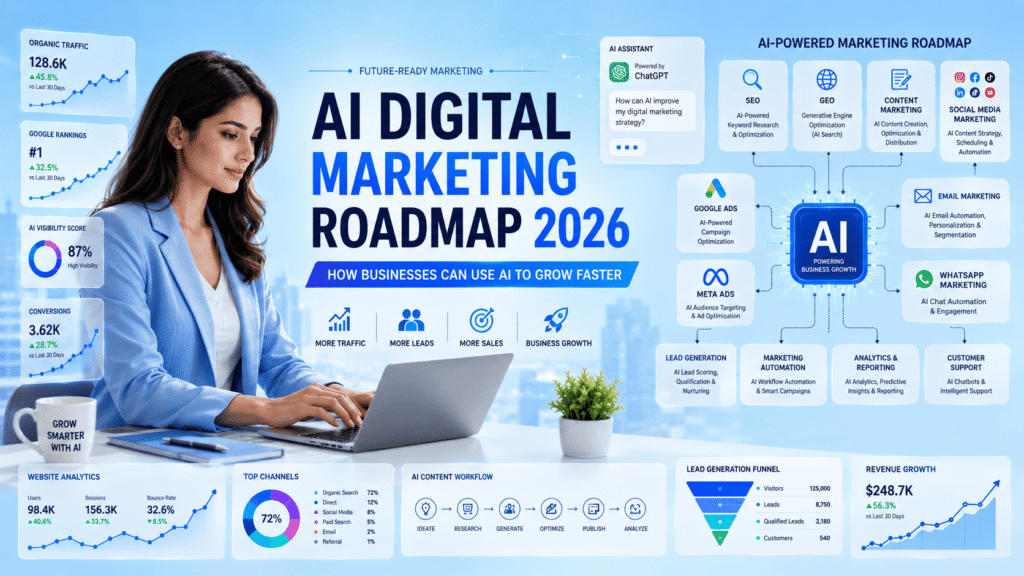
How Businesses Can Use AI for Digital Marketing in 2026: Complete Roadmap Introduction Artificial Intelligence is no longer a futuristic concept reserved for large corporations with massive budgets. In 2026, AI has become one of the most powerful tools available to businesses of all sizes. From startups and local businesses to e-commerce brands and global enterprises, companies are using AI to improve efficiency, create better marketing campaigns, generate more leads, and make smarter decisions. The challenge is that many business owners know AI is important but don’t know where to start. They hear about ChatGPT, Google Gemini, AI-powered SEO tools, marketing automation platforms, and AI content creation software, but they often struggle to understand how these technologies fit into a practical digital marketing strategy. This AI Digital Marketing Roadmap provides a complete guide to how businesses can use AI across every major digital marketing channel. Whether your goal is increasing organic traffic, generating more leads, improving customer engagement, or scaling your marketing efforts, this roadmap will help you understand exactly where AI can create the biggest impact. What Is AI Digital Marketing? AI digital marketing refers to the use of artificial intelligence technologies to improve marketing activities, automate repetitive tasks, analyze customer behavior, create content, optimize campaigns, and enhance decision-making. Instead of replacing marketers, AI acts as a powerful assistant that helps businesses work faster and more efficiently. Common applications include: The most successful businesses in 2026 are not replacing humans with AI. They are combining human creativity with AI efficiency. Why AI Matters for Businesses in 2026 Consumer behavior has changed significantly. Customers now interact with brands through: As competition increases, businesses need smarter ways to attract attention and convert visitors into customers. AI helps businesses: Save Time Tasks that once required hours can often be completed in minutes. Improve Productivity Teams can focus on strategy while AI handles repetitive work. Reduce Marketing Costs Automation lowers operational expenses. Improve Customer Experience AI can deliver personalized experiences at scale. Increase Marketing Performance Data-driven insights lead to better campaigns and higher ROI. Key Benefits of Using AI in Digital Marketing Better Content Creation AI helps generate blog ideas, outlines, social media posts, and marketing copy. Faster Market Research Businesses can analyze competitors and customer behavior more efficiently. Improved SEO Performance AI tools can identify keyword opportunities, content gaps, and optimization recommendations. Smarter Advertising AI helps optimize targeting, bidding strategies, and ad creatives. Enhanced Lead Generation Businesses can identify and nurture prospects more effectively. Better Analytics AI can uncover insights hidden within large datasets. The Complete AI Digital Marketing Roadmap Step 1: Use AI for Market Research Every successful marketing campaign starts with understanding your audience. AI tools can help businesses identify: Recommended Tools: Example: A local digital marketing agency can use AI to discover that business owners are increasingly searching for “AI Search Optimization” and “Google AI Overviews SEO.” This insight can guide future content strategies. Best Practice Always validate AI-generated research using real-world data sources such as Google Trends and Search Console. Step 2: Use AI for SEO SEO remains one of the highest ROI marketing channels. AI can significantly improve: Recommended Tools: AI can help identify content opportunities, optimize articles, and improve visibility across both traditional search engines and AI-powered search experiences. Businesses that combine SEO and AI Search Optimization are better positioned to succeed in 2026. Step 3: Use AI for Content Creation Content remains the foundation of digital marketing. AI can assist with: Recommended Tools: However, businesses should never publish AI-generated content without human review. The most effective content combines AI efficiency with human expertise and industry knowledge. Step 4: Use AI for Social Media Marketing Social media marketing has become increasingly competitive. Businesses need consistent content, creative ideas, audience engagement, and performance tracking. AI can help simplify this process. How AI Helps Social Media Marketing Recommended Tools Practical Example A small business owner can use ChatGPT to generate 30 Instagram post ideas in minutes instead of spending hours brainstorming content. Expert Recommendation Use AI for content planning and first drafts, but always add your brand voice, personal experiences, and industry expertise before publishing. Step 5: Use AI for Video Marketing Video content continues to dominate digital marketing. Short-form videos on: are generating massive engagement. How AI Helps Video Marketing Recommended Tools Practical Example A marketing agency can convert a 2,000-word blog into multiple short-form videos using AI-powered editing tools. Step 6: Use AI for Google Ads Google Ads remains one of the fastest ways to generate leads and sales. AI helps businesses improve: Recommended Tools Best Practice Never rely entirely on AI-generated ads. Always review ad copy to ensure accuracy and compliance with Google Ads policies. Step 7: Use AI for Meta Ads Meta platforms continue to be powerful channels for businesses. AI can improve: Recommended Tools Example An e-commerce brand can use AI to create multiple ad variations and test different messaging without increasing design costs. Step 8: Use AI for Email Marketing Email marketing remains one of the highest ROI digital marketing channels. AI can help with: Recommended Tools Practical Example Businesses can automatically personalize email campaigns based on customer interests and purchase behavior. Step 9: Use AI for WhatsApp Marketing WhatsApp marketing is becoming increasingly important for businesses. AI helps with: Recommended Tools Benefits Step 10: Use AI for Lead Generation Generating qualified leads is one of the most important goals for any business. AI can help identify prospects, score leads, and automate outreach. Recommended Tools Example A B2B company can use AI to identify decision-makers and create personalized outreach campaigns at scale. Step 11: Use AI for Customer Support Customers expect quick responses. AI-powered chatbots can: Recommended Tools Best Practice Use AI to handle routine queries while allowing human agents to manage complex situations. Step 12: Use AI for Analytics and Reporting Data is one of the most valuable business assets. AI helps businesses understand: Recommended Tools Practical Example Instead of manually reviewing reports, businesses can use AI to summarize performance

How Businesses Can Use AI for Digital Marketing in 2026: Complete Roadmap Read More »

SEO and GEO AI Tools

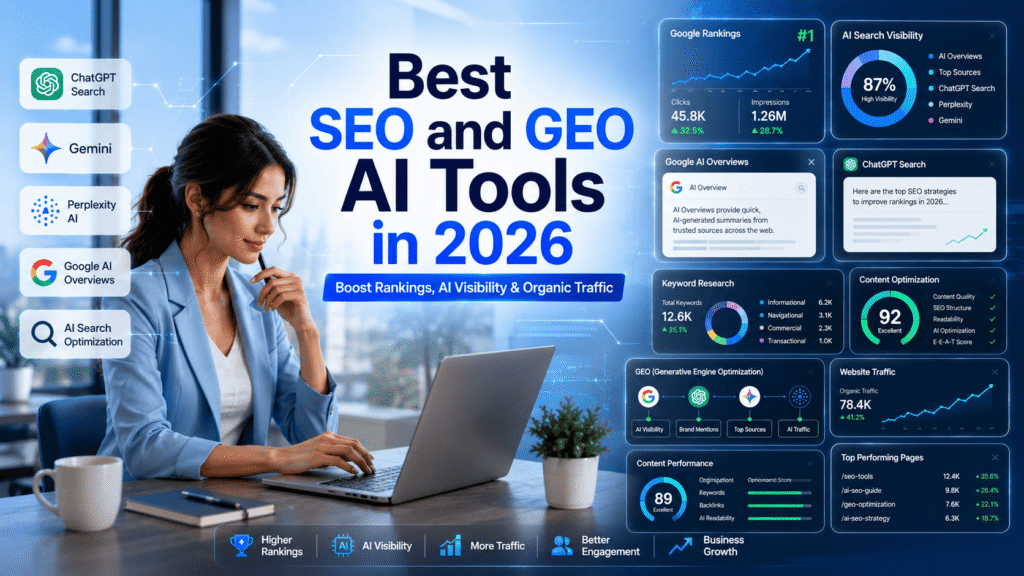
Best SEO and GEO AI Tools in 2026: Complete Guide

Best SEO and GEO AI Tools in 2026: Complete Guide Introduction Search engine optimization is changing faster than ever. For years, businesses focused primarily on ranking on traditional search engines such as Google and Bing. However, the rise of AI-powered search experiences, including Google AI Overviews, ChatGPT Search, Gemini, and Perplexity, has created an entirely new challenge: how to remain visible when AI systems generate answers directly for users. This shift has led to the growing importance of SEO and GEO AI Tools. Traditional SEO helps websites rank in search engine results pages, while Generative Engine Optimization (GEO) focuses on improving visibility within AI-generated answers and conversational search experiences. Businesses that understand both disciplines are gaining a significant competitive advantage. Whether you are a business owner, marketer, freelancer, startup founder, or agency professional, understanding the best SEO and GEO AI Tools can help improve search visibility, increase organic traffic, strengthen brand authority, and generate more qualified leads. In this guide, we will explore the most effective SEO and GEO AI Tools available in 2026, how they work, and how businesses can use them to build sustainable online growth. What Are SEO and GEO AI Tools? SEO and GEO AI Tools are software platforms designed to improve a website’s visibility across both traditional search engines and AI-powered search environments. SEO Tools SEO tools focus on: Examples include: GEO Tools GEO tools focus on: Examples include: As AI search becomes more popular, businesses need both SEO and GEO strategies to maintain visibility. Why SEO and GEO AI Tools Matter in 2026 Many marketers are still optimizing only for Google rankings. The problem is that user behavior is changing. People now search using: Instead of clicking multiple search results, users increasingly receive direct AI-generated answers. This means businesses must optimize for: Traditional Search Visibility Ranking on Google Search results. AI Search Visibility Being referenced and cited by AI systems. Entity Recognition Helping AI understand your brand, products, services, and expertise. Content Authority Building trust through comprehensive and authoritative content. SEO and GEO AI Tools help marketers measure and improve performance across these new search environments. SEO vs GEO: Understanding the Difference SEO GEO Optimizes for search engines Optimizes for AI engines Focuses on rankings Focuses on AI citations Uses keywords Uses entities and context Targets search results Targets AI-generated answers Measures organic traffic Measures AI visibility Businesses that combine SEO and GEO strategies gain the best results because they capture both traditional and AI-driven traffic. Key Benefits of SEO and GEO AI Tools Improved Search Visibility These tools help businesses appear in more places across the internet. Better Content Optimization AI tools identify content gaps and opportunities. Stronger Competitive Analysis Businesses can discover what competitors are doing successfully. Higher Organic Traffic Better optimization leads to more qualified visitors. Enhanced AI Search Presence GEO tools improve visibility in AI-generated search experiences. More Efficient Workflows Automation reduces time spent on repetitive SEO tasks. Best SEO AI Tools in 2026 1. Ahrefs Ahrefs remains one of the most powerful SEO platforms available. Best For: Key Features: Pros: Cons: 2. Semrush Semrush provides a complete digital marketing toolkit. Best For: Key Features: Pros: Cons: 3. Google Search Console Google Search Console remains one of the most important free SEO tools. Best For: Key Features: Pros: Cons: 4. Screaming Frog Screaming Frog helps identify technical SEO issues. Best For: Key Features: Pros: Cons: 5. Surfer SEO Surfer SEO focuses on content optimization. Best For: Key Features: Pros: Cons: Internal Link Suggestions External Link Suggestions

Best SEO and GEO AI Tools in 2026: Complete Guide Read More »

ChatGPT Marketing Prompts for Businesses

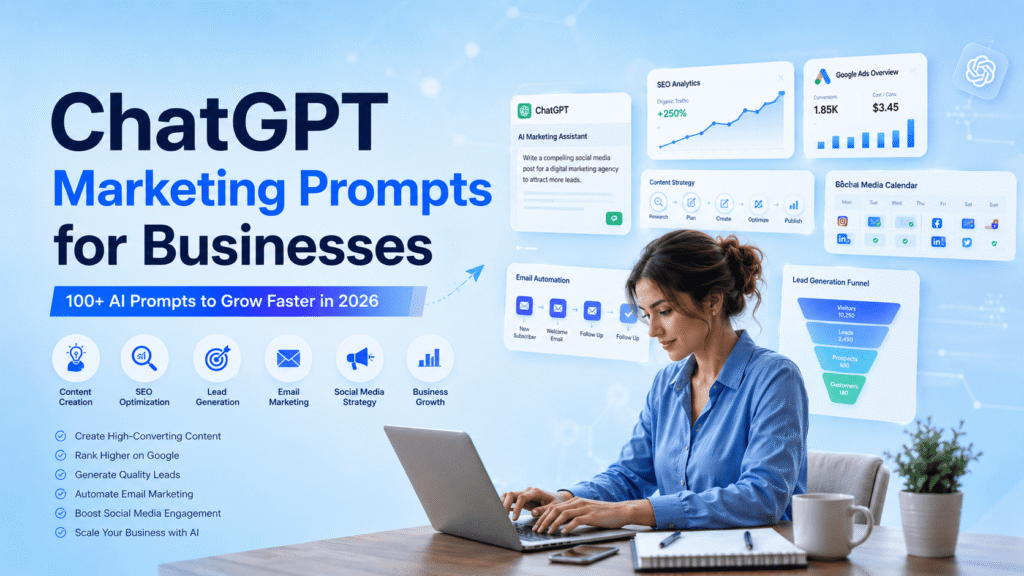
ChatGPT Marketing Prompts for Businesses in 2026

ChatGPT Marketing Prompts for Businesses in 2026 Introduction Artificial intelligence is no longer a futuristic concept reserved for large technology companies. In 2026, businesses of every size are using AI tools such as ChatGPT to create content, generate leads, improve SEO, write advertisements, automate customer communication, and streamline marketing operations. However, many business owners make the same mistake: they open ChatGPT, ask a basic question, and receive average results. The difference between mediocre AI output and exceptional marketing results often comes down to one thing—prompt quality. A prompt is simply the instruction you give to ChatGPT. The better your prompt, the better the output. Whether you are a business owner, freelancer, startup founder, digital marketer, agency owner, or student learning modern marketing strategies, understanding how to use ChatGPT marketing prompts effectively can save countless hours while improving campaign performance. This guide explains exactly how businesses can use ChatGPT marketing prompts in 2026 to create better content, improve SEO, generate leads, increase engagement, optimize advertising campaigns, and stay competitive in an increasingly AI-driven marketplace. Businesses using ChatGPT Marketing Prompts for Businesses can save time, improve content quality, generate better marketing ideas, and streamline daily operations. From SEO and social media marketing to email campaigns and advertising, ChatGPT Marketing Prompts for Businesses help organizations scale their marketing efforts more efficiently. What Are ChatGPT Marketing Prompts? ChatGPT marketing prompts are detailed instructions that guide ChatGPT to perform specific marketing tasks. Instead of asking: “Write an Instagram post.” A better prompt would be: “Act as an Instagram marketing strategist. Create a high-engagement Instagram post for a digital marketing agency targeting small business owners. Use a professional tone, include a compelling hook, actionable advice, and a call-to-action encouraging consultation bookings.” The second prompt provides: As a result, the output becomes significantly more valuable. ChatGPT Marketing Prompts for Businesses help companies create content, generate campaign ideas, and improve marketing productivity. Many marketers now rely on ChatGPT Marketing Prompts for Businesses to streamline social media management and content planning. The biggest advantage of ChatGPT Marketing Prompts for Businesses is the ability to save time while maintaining consistent marketing output. Small businesses can use ChatGPT Marketing Prompts for Businesses to create email campaigns, blog outlines, and advertising copy faster. As AI adoption grows, ChatGPT Marketing Prompts for Businesses are becoming an essential part of modern digital marketing strategies. Why ChatGPT Marketing Prompts Matter in 2026 AI adoption continues to accelerate across industries. Businesses are now using ChatGPT for: The companies achieving the best results are not necessarily using better AI tools—they are using better prompts. Well-structured prompts help businesses: Key Benefits of Using ChatGPT Marketing Prompts Faster Content Creation Businesses can generate high-quality marketing assets in minutes instead of hours. Improved Marketing Consistency Prompt frameworks help maintain consistent messaging across channels. Better Campaign Performance AI-assisted research can identify stronger angles, headlines, and content ideas. Increased Productivity Teams spend less time brainstorming and more time executing. Cost Efficiency Businesses can reduce dependence on multiple software tools and outsourcing costs. The Prompt Formula Every Business Should Use The highest-performing marketing prompts generally follow this structure: Role + Goal + Audience + Context + Requirements + Desired Output Example: “Act as an SEO content strategist. Create a blog outline about local SEO for dentists. Target small dental clinic owners. Include keyword opportunities, FAQs, content clusters, and AI Search optimization recommendations. Present the output as a structured content plan.” This framework consistently produces stronger results. SEO Prompts for Businesses SEO Prompt #1 Act as an SEO strategist. Generate 20 low-competition blog topics for a digital marketing agency targeting local businesses. SEO Prompt #2 Analyze the keyword “[KEYWORD]” and provide: SEO Prompt #3 Create a complete SEO blog outline targeting the keyword “[KEYWORD]” with H1, H2, H3 headings and FAQ sections. SEO Prompt #4 Generate semantic keywords and topical entities related to “[KEYWORD]”. SEO Prompt #5 Suggest internal linking opportunities for a website focused on digital marketing services. Content Marketing Prompts Content Prompt #1 Create a 2,500-word SEO-optimized blog post targeting [KEYWORD]. Content Prompt #2 Generate 30 blog topic ideas based on current digital marketing trends. Content Prompt #3 Rewrite this article to improve readability while maintaining SEO value. Content Prompt #4 Convert this blog post into a LinkedIn article. Content Prompt #5 Create a content calendar for the next 30 days targeting business owners. Social Media Marketing Prompts Instagram Prompt #1 Create an Instagram carousel explaining [TOPIC] with 10 slides. Instagram Prompt #2 Generate 20 Instagram Reel ideas for a digital marketing agency. Instagram Prompt #3 Write an Instagram caption optimized for engagement and saves. Instagram Prompt #4 Generate Instagram Story poll ideas related to SEO and social media marketing. Instagram Prompt #5 Create a complete Instagram Growth Strategy for a new business account. Google Ads Prompts Google Ads Prompt #1 Create 15 Google Ads headlines and 4 descriptions for a digital marketing agency. Google Ads Prompt #2 Generate high-intent keywords for businesses searching for SEO services. Google Ads Prompt #3 Analyze competitor advertising angles for local SEO services. Google Ads Prompt #4 Create a conversion-focused landing page outline for Google Ads traffic. Google Ads Prompt #5 Generate negative keyword suggestions for a digital marketing campaign. (Continue with Meta Ads, Email Marketing, Lead Generation, AI Search Optimization, Case Study, Comparison Table, Expert Tips, Common Mistakes, Future Trends, Conclusion, and FAQs.) Internal Resources to Improve Your Marketing Results How to Rank in Google AI https://socialdigimarq.com/how-to-rank-in-google-ai-search/ For additional AI resources, visit OpenAI:https://openai.com For SEO best practices, visit Google Search Central:https://developers.google.com/search For keyword research and trend analysis, visit Google Trends:https://trends.google.com For social media advertising resources, visit Meta Business:https://www.facebook.com/business Best AI Marketing Tools for Businesses in 2026 Tool Best Use Case ChatGPT Content creation, copywriting, strategy development Google Gemini Research and information gathering Claude Long-form content writing and document analysis Canva AI Graphic design and social media creatives Google Trends Trend discovery and keyword research Notion AI Productivity and content planning CapCut AI Video editing and short-form content creation Perplexity AI Research and source discovery

ChatGPT Marketing Prompts for Businesses in 2026 Read More »

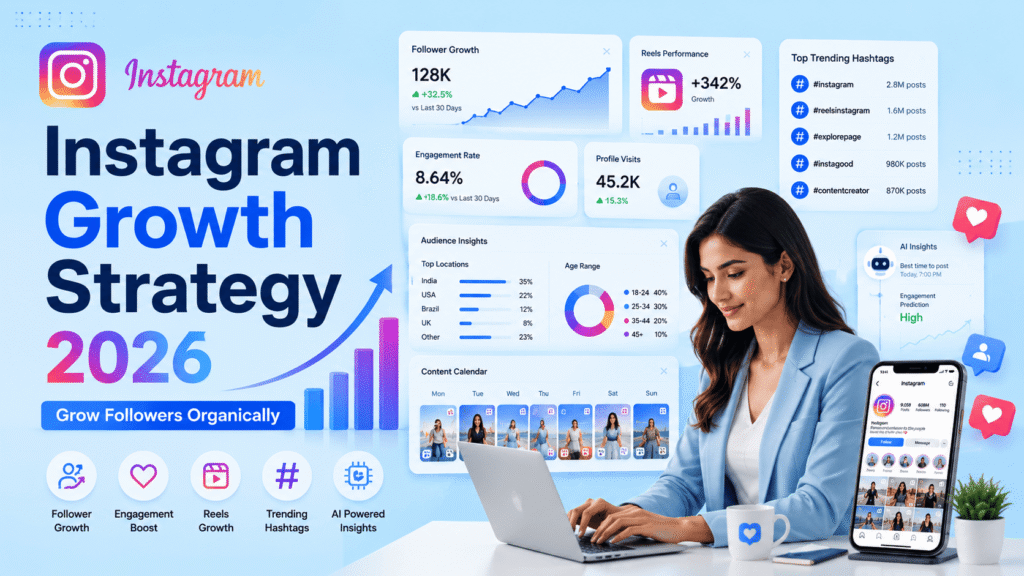
Instagram Growth Strategy in 2026 showing organic follower growth, engagement tactics, content planning, and Instagram marketing success.

Instagram Growth Strategy in 2026: Complete Guide to Reach More Followers Organically

Instagram Growth Strategy in 2026: Complete Guide to Reach More Followers Organically Introduction If you’ve been posting consistently on Instagram but your follower count barely moves, you’re not alone. Many creators, freelancers, businesses, and marketers are experiencing the same challenge. Instagram is more competitive than ever, and strategies that worked a few years ago no longer deliver the same results. The good news is that organic growth is still possible in 2026. The Instagram algorithm has evolved, but it continues to reward creators and brands that consistently provide valuable content and meaningful engagement. The focus has shifted away from vanity metrics and toward genuine audience interaction. Whether you’re a business owner promoting services, a freelancer building your personal brand, an entrepreneur generating leads, or a student learning digital marketing, understanding the latest Instagram Growth Strategy in 2026 can help you reach the right audience without relying entirely on paid advertisements. This guide explains everything you need to know about growing organically on Instagram, including profile optimization, content creation, engagement strategies, algorithm insights, AI-powered discovery, and future trends. Instagram Growth Strategy in 2026 is no longer about posting random content. Businesses and creators need a data-driven approach to attract followers organically. Best Instagram Growth Strategy in 2026 for Businesses An Instagram growth strategy is a structured plan designed to increase followers, reach, engagement, and brand visibility over time. Instead of relying on random posting or viral luck, a growth strategy focuses on: In 2026, successful Instagram growth requires combining creativity with data-driven decision-making. Why Instagram Growth Matters in 2026 Instagram remains one of the most powerful platforms for: A strong Instagram presence can help businesses: The brands that invest in organic growth today are creating long-term marketing assets that continue delivering results for years. Key Benefits of Organic Instagram Growth Higher Quality Followers Organic followers are genuinely interested in your content and are more likely to become customers. Better Engagement Rates Organic audiences interact more frequently through comments, saves, shares, and direct messages. Lower Marketing Costs You can reduce dependence on paid advertising by building a loyal audience. Long-Term Sustainability Organic content continues generating visibility long after publication. Improved Brand Authority Consistent educational and valuable content positions you as an industry expert. Understanding the Instagram Algorithm in 2026 Many users still believe Instagram growth depends on posting frequency alone. In reality, the algorithm evaluates multiple engagement signals. Strong Ranking Signals Moderate Ranking Signals Weak Ranking Signals The algorithm prioritizes content that keeps users engaged for longer periods and encourages meaningful interactions. A successful Instagram Growth Strategy in 2026 combines Reels, SEO optimization, community engagement, and consistent content publishing. Step 1: Optimize Your Instagram Profile Your profile is your digital storefront. Profile Optimization Checklist ✓ Professional profile picture ✓ Keyword-rich username ✓ Clear niche positioning ✓ Compelling bio ✓ Website link ✓ Story highlights ✓ Consistent branding Example Instead of: “Helping businesses grow.” Use: “Helping businesses grow with SEO, Google Ads & Social Media Marketing.” This instantly communicates value. Step 2: Define Your Content Pillars Content pillars help maintain consistency and relevance. Recommended Content Pillars Educational Content Teach your audience something valuable. Examples: Authority Content Showcase expertise. Examples: Personal Content Build trust and connection. Examples: Engagement Content Encourage audience interaction. Examples: Step 3: Create High-Performing Reels Reels remain the fastest growth tool on Instagram. Winning Reel Structure Hook → Value → Call-to-Action Example: Hook:“Most Instagram accounts fail because of this mistake.” Value:Explain the mistake. CTA:“Save this Reel for later.” Best Reel Categories Step 4: Use Instagram SEO Instagram is increasingly becoming a search engine. Users search for: Instagram SEO Best Practices Step 5: Focus on Shareable Content Shares are among the strongest growth signals. Content that gets shared often reaches audiences beyond your followers. Highly Shareable Content Ask yourself: “Would someone send this to a friend?” If the answer is yes, you’re on the right track. Step 6: Improve Engagement Strategically Many creators wait for engagement. Successful creators initiate engagement. Effective Engagement Tactics The more conversations you create, the more visibility Instagram provides. Step 7: Build a Consistent Posting Schedule Consistency builds trust. Recommended posting frequency: Content Type Frequency Reels 4–7 per week Carousels 2–3 per week Stories Daily Lives 1–2 per month Consistency is more important than volume. Step 8: Leverage User-Generated Content User-generated content builds trust faster than traditional marketing. Examples include: People trust people more than brands. Step 9: Collaborate with Relevant Creators Collaborations can significantly increase reach. Look for creators with: Collaboration ideas: Step 10: Track Performance Metrics Growth requires measurement. Monitor: Analyze your best-performing content monthly and create more of what works. Tools and Resources Useful Instagram growth tools: These tools help improve content creation and performance analysis. Real-World Example Imagine a digital marketing agency posting generic promotional content. Results: The agency switches to: After six months: The difference is value-driven content. Common Mistakes to Avoid Posting Without a Strategy Random content creates inconsistent results. Solution:Develop clear content pillars. Ignoring Analytics Without data, improvement becomes difficult. Solution:Review performance monthly. Buying Followers Purchased followers damage engagement rates. Solution:Focus on authentic growth. Overusing Hashtags Too many irrelevant hashtags reduce effectiveness. Solution:Use targeted hashtags. Inconsistent Posting Long gaps reduce visibility. Solution:Create a content calendar. Poor Hooks Weak openings reduce watch time. Solution:Capture attention within three seconds. Ignoring Community Building Instagram rewards interaction. Solution:Engage consistently with followers. Expert Tips for Faster Results Future Trends for Instagram Growth Beyond 2026 Several trends will shape Instagram marketing: AI-Powered Content Discovery Instagram will continue improving personalized recommendations. Search-Based Social Media Keywords will become increasingly important. Short-Form Educational Content Quick, actionable content will dominate. Creator Commerce More creators will sell products directly within Instagram. AI Search Visibility Content optimized for AI-powered search platforms will gain additional traffic opportunities. Internal Linking Opportunities For Social Digi Marq, consider linking to: Internal linking improves SEO and user experience. Whether you are a business owner, freelancer, or content creator, implementing the right Instagram Growth Strategy in 2026 can help you achieve sustainable growth. Conclusion Growing on Instagram in

Instagram Growth Strategy in 2026: Complete Guide to Reach More Followers Organically Read More »

Meta Ads Automation

Meta Ads Automation Guide for Beginners in 2026

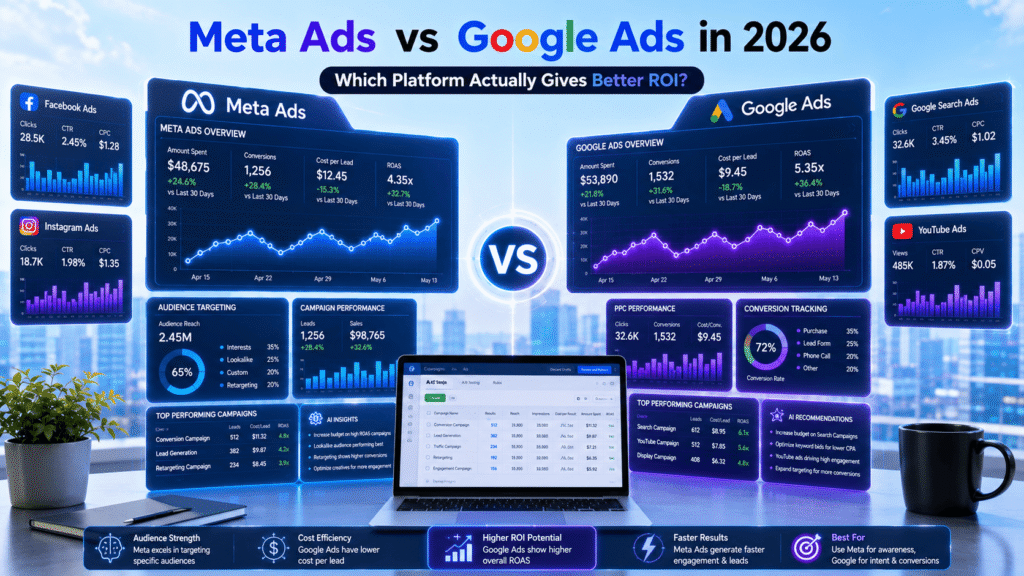
Meta Ads Automation Guide for Beginners in 2026 Digital advertising in 2026 feels completely different from what marketers experienced just a few years ago. AI automation is now deeply integrated into almost every advertising platform, audience behavior has changed dramatically, and competition for customer attention is becoming more expensive every month. For many businesses, one question still creates confusion: Should you invest in Meta Ads or Google Ads? Some marketers believe Meta Ads generate cheaper traffic and faster engagement. Others argue that Google Ads deliver stronger conversion intent and more profitable customers. The reality is more complicated because both platforms work in very different ways. After analyzing current advertising trends, campaign structures, and AI-powered automation systems, one thing becomes clear: businesses that understand how each platform works are outperforming competitors who simply spend money without strategy. In this detailed guide, we will compare Meta Ads vs Google Ads in 2026, understand which platform delivers better ROI, explore AI-driven advertising changes, and discover how businesses can build profitable marketing campaigns without wasting budget. Understanding Meta Ads in 2026 Meta Ads include advertising across Facebook, Instagram, Messenger, and the Meta Audience Network. Over the past few years, Meta has aggressively improved its AI advertising systems to make campaigns smarter and easier to scale. Instead of manually targeting every audience, advertisers can now rely on AI-powered campaign optimization, predictive customer behavior, and automated placements. One reason businesses still love Meta Ads is because they are excellent for visual storytelling. People scrolling Instagram or Facebook are not always searching for products directly, but strong creatives can interrupt attention and create interest instantly. This makes Meta Ads highly effective for: Meta Ads are especially powerful when brands focus on emotional connection, engaging visuals, and audience psychology rather than direct selling. Understanding Google Ads in 2026 Google Ads operate differently because the platform is built around search intent. Users actively search for solutions, products, or services. That changes everything. A person searching “best running shoes for beginners” already has purchase intent. A person searching “emergency dentist near me” is likely ready to book immediately. This is why Google Ads often produce higher conversion quality even if the clicks are more expensive. Google Ads in 2026 now rely heavily on AI systems like: Google’s machine learning systems analyze search behavior in real time to improve campaign efficiency and maximize conversions. The Biggest Difference Between Meta Ads and Google Ads The core difference between Meta Ads and Google Ads comes down to user intent. Meta Ads create demand. Google Ads capture demand. This distinction is extremely important for businesses trying to improve ROI. For example: A user scrolling Instagram may suddenly discover a skincare brand through a visually appealing ad. They were not actively searching for the product, but the ad created curiosity. Meanwhile, a Google user searching “best skincare products for acne scars” already wants a solution. That person is much closer to making a purchase. This is why Meta Ads are often stronger for awareness and discovery, while Google Ads usually perform better for direct conversions. Which Platform Gives Better ROI in 2026? The answer depends entirely on the type of business you run. Many businesses make the mistake of searching for a “best platform” without understanding their customer behavior. In reality, ROI depends on: When Meta Ads Usually Perform Better Meta Ads generally produce better ROI for businesses that rely on emotional marketing and visual engagement. These include: Meta’s AI system is now extremely good at finding users who are likely to engage with visual content. In many industries, Meta Ads still generate: However, lower cost does not automatically mean better profitability. That is where many beginners make mistakes. When Google Ads Usually Perform Better Google Ads often generate stronger ROI for businesses where customer intent matters more than visual discovery. These industries include: People using Google Search are actively looking for answers, which increases conversion probability significantly. Although CPC is often higher on Google Ads, conversion quality can be much stronger because users already want a solution. The Real Problem With ROI Tracking One thing many marketers misunderstand is that ROI is not only about cheap clicks. Some campaigns produce thousands of low-cost visitors who never convert into paying customers. Other campaigns generate fewer clicks but significantly higher profits. This is why experienced advertisers focus on: Businesses that only focus on low CPC usually waste advertising budget. AI Automation Is Changing Advertising Completely AI automation is now dominating digital advertising. Both Meta Ads and Google Ads heavily rely on machine learning systems to optimize campaigns automatically. In 2026, advertisers no longer manually control every small detail like before. Instead, AI systems now help with: This creates huge opportunities for businesses that understand how to work with AI instead of fighting against it. Meta Ads AI Features in 2026 Meta has introduced powerful automation features such as: These systems help advertisers scale campaigns faster with less manual work. However, businesses still need strong creative strategy because AI cannot completely replace human psychology and storytelling. Google Ads AI Features in 2026 Google Ads now heavily promote: Google’s AI system constantly analyzes search behavior and user activity to improve conversion performance. This makes Google Ads highly effective for businesses targeting high-intent audiences. Which Platform Is Better for Beginners? For most beginners, Meta Ads are usually easier to understand because campaigns are visually driven and easier to launch. Google Ads can feel more technical due to: However, beginners should not rely completely on automation. Understanding audience behavior still matters more than AI tools. Why Smart Businesses Use Both Platforms The highest-performing businesses in 2026 rarely depend on only one platform. Instead, they combine Meta Ads and Google Ads strategically. For example: This full-funnel strategy usually creates better long-term ROI than using only one advertising platform. Common Advertising Mistakes Businesses Still Make Even with advanced AI systems, many businesses continue making the same mistakes. These include: Advertising platforms are tools. Success still depends on strategy and execution. The

Meta Ads Automation Guide for Beginners in 2026 Read More »

AI-powered Meta Ads automation dashboard for Facebook and Instagram marketing in 2026

AI-Powered Meta Ads Automation Guide for Beginners in 2026

AI-Powered Meta Ads Automation Guide for Beginners in 2026 Introduction Artificial intelligence is rapidly changing the future of digital marketing, and Meta advertising is one of the biggest areas where automation is becoming essential. Businesses, creators, startups, and marketers are now using AI-powered Meta Ads automation to improve advertising performance, reduce manual work, increase conversion rates, and generate better-quality leads from Facebook and Instagram campaigns. In 2026, Meta Ads automation is no longer an advanced strategy used only by large brands. Even beginners can now use AI tools to create ad copy, optimize targeting, automate bidding strategies, analyze customer behavior, improve audience segmentation, and scale advertising campaigns more effectively. Modern AI systems are helping advertisers save time while improving advertising accuracy and return on investment. The biggest advantage of AI-powered Meta Ads automation is the ability to make faster decisions based on real-time data. Traditional advertising methods required marketers to manually test audiences, monitor campaign performance, and adjust settings daily. Now AI can automate most of these tasks using machine learning and predictive analytics. Businesses that fail to adapt to AI-driven advertising systems may struggle to compete in the future digital marketing industry. Platforms like Facebook and Instagram are increasingly relying on automation algorithms to optimize ad delivery, understand user interests, and improve customer engagement. This means marketers must learn how AI-powered Meta Ads automation works if they want to stay competitive. This beginner guide explains how AI-powered Meta Ads automation works in 2026, the best AI tools available for Meta advertising, automation strategies, targeting techniques, common mistakes, and future trends in AI social media marketing. What Is AI-Powered Meta Ads Automation? AI-powered Meta Ads automation refers to using artificial intelligence systems and machine learning technology to automate Facebook and Instagram advertising campaigns. Instead of manually managing every advertising task, AI tools can automatically optimize campaigns based on data and user behavior. These systems can help advertisers: Modern Meta Ads automation tools use real-time data analysis to make intelligent advertising decisions. AI algorithms continuously monitor campaign performance and automatically adjust strategies for better results. For beginners, this makes digital advertising easier because AI handles many technical optimization tasks automatically. Why AI-Powered Meta Ads Automation Is Growing in 2026 The growth of AI-powered Meta Ads automation in 2026 is driven by several important factors. 1. Rising Competition in Digital Advertising Millions of businesses now advertise on Facebook and Instagram. Manual advertising strategies are becoming less effective because competition is increasing every year. AI helps advertisers stay competitive through smarter optimization systems. 2. Better Audience Targeting AI systems can study customer behavior patterns and identify high-converting audiences more accurately than manual targeting methods. 3. Faster Campaign Optimization AI tools can automatically improve campaigns in real time without requiring constant manual changes from marketers. 4. Improved ROI Businesses using AI-powered Meta Ads automation often achieve better return on ad spend because AI reduces wasted advertising budgets. 5. Time-Saving Automation AI reduces repetitive marketing tasks such as campaign testing, audience segmentation, reporting, and optimization. How AI Meta Ads Automation Works AI-powered advertising systems use machine learning algorithms to process large amounts of customer data. These systems analyze user interests, demographics, online behavior, engagement activity, and purchasing patterns. The automation process usually includes: Audience Analysis AI studies user behavior to identify people most likely to engage with advertisements. Ad Creative Optimization AI tools test multiple headlines, descriptions, and visuals to find the best-performing combinations. Smart Bidding AI automatically adjusts bidding strategies based on campaign goals and audience behavior. Conversion Tracking AI systems track user actions such as clicks, sign-ups, purchases, and form submissions. Predictive Analytics Machine learning predicts future campaign performance and suggests optimization improvements. Best AI Tools for Meta Ads Automation in 2026 1. AdCreative.ai AdCreative.ai helps marketers generate AI-powered advertising creatives optimized for Facebook and Instagram campaigns. Features: 2. Revealbot Revealbot is one of the most popular Meta Ads automation platforms for campaign optimization. Features: 3. Madgicx Madgicx combines AI targeting and automation systems for Facebook advertising. Features: 4. Meta Advantage+ Meta’s built-in Advantage+ system uses automation for audience targeting and campaign optimization. Features: AI Audience Targeting Strategies Audience targeting is one of the most important parts of Meta advertising. AI systems help businesses improve targeting accuracy through behavioral analysis. Lookalike Audience Automation AI can automatically identify users similar to existing customers. Interest Prediction Machine learning predicts customer interests based on engagement activity. Behavioral Targeting AI tracks online behavior patterns to improve advertising relevance. Dynamic Segmentation AI automatically updates audience groups based on performance data. Benefits of AI-Powered Meta Ads Automation Better Conversion Rates AI improves advertising relevance, which increases conversions. Lower Advertising Costs Automation reduces wasted spending on low-performing audiences. Faster Scaling Businesses can scale successful campaigns more efficiently. Real-Time Optimization AI continuously improves campaigns while advertisements are running. Smarter Decision Making AI provides valuable marketing insights based on real-time analytics. Common Mistakes Beginners Make Over-Reliance on Automation AI is powerful, but marketers still need strategic planning. Poor Creative Quality AI optimization cannot fix weak ad creatives. Wrong Campaign Objectives Choosing incorrect goals reduces campaign performance. Ignoring Analytics Marketers should still monitor reports and performance data. Future of AI-Powered Meta Ads Automation The future of AI-powered advertising will focus on deeper personalization, predictive customer analysis, AI-generated creatives, voice-based search integration, and advanced automation systems. Future Meta advertising may include: Businesses adopting these technologies early will gain a major competitive advantage. Final Thoughts AI-powered Meta Ads automation is transforming Facebook and Instagram advertising in 2026. Beginners can now use artificial intelligence to improve audience targeting, automate campaign management, optimize advertising creatives, and increase lead generation performance with less manual effort. As competition grows in the digital advertising industry, businesses using AI-powered Meta Ads automation will have stronger marketing efficiency, better customer targeting, improved return on investment, and faster campaign scalability. The future of digital marketing belongs to businesses that combine human creativity with artificial intelligence systems. Learning AI-powered Meta Ads automation today can help marketers stay competitive, improve advertising performance, and build

AI-Powered Meta Ads Automation Guide for Beginners in 2026 Read More »

Best AI tools for Meta Ads lead generation in 2026 digital marketing banner

Best AI Tools for Meta Ads Lead Generation in 2026

Best AI Tools for Meta Ads Lead Generation in 2026 Introduction Artificial intelligence is transforming digital advertising faster than ever before. In 2026, Meta Ads platforms including Facebook Ads and Instagram Ads are heavily powered by machine learning and AI-driven optimization systems. Businesses are now using advanced AI tools to improve audience targeting, ad copy generation, conversion optimization, lead generation, customer engagement, and campaign automation. Traditional Meta Ads strategies are no longer enough because advertising competition is increasing every year. Brands now need smarter optimization, better creatives, stronger targeting, lower cost per lead, and AI-powered automation systems. This is why AI marketing tools are becoming essential for modern digital marketers. Why AI Is Important for Meta Ads in 2026 Meta platforms rely heavily on artificial intelligence systems. Facebook and Instagram algorithms analyze user interests, engagement behavior, watch time, click patterns, and purchase history. AI helps businesses improve ROI, reduce advertising costs, increase conversions, automate optimization, and scale lead generation. Best AI Tools for Meta Ads Lead Generation in 2026 1. ChatGPT ChatGPT helps marketers generate Meta Ads copy, headlines, CTA variations, and conversion-focused customer messaging. 2. AdCreative.ai AdCreative.ai helps businesses create AI-powered Meta Ads creatives and automated advertising visuals. 3. Jasper AI Jasper AI supports AI copywriting, landing pages, email marketing, and advertising workflows. 4. Canva AI Canva AI improves ad design, social media creatives, promotional graphics, and visual optimization. 5. HubSpot AI HubSpot AI helps automate lead tracking, CRM management, email workflows, and customer segmentation. AI Audience Targeting AI targeting systems analyze demographics, engagement patterns, buyer intent, and customer behavior to improve Meta Ads performance. AI Automation for Meta Ads Businesses now automate customer responses, retargeting systems, email follow-ups, lead tracking, and campaign optimization using artificial intelligence. Future of AI Advertising Future AI advertising trends include predictive targeting, AI-generated videos, personalized advertising systems, AI-powered customer journeys, and virtual influencer campaigns. Internal Links AI Tools for Social Media Marketing in 2026 How Brands Are Using AI Influencers in 2026 YouTube Shorts vs Instagram Reels External Links OpenAI Meta Business Canva Conclusion Artificial intelligence is reshaping Meta Ads lead generation in 2026. Businesses are increasingly using AI tools to automate advertising, improve targeting, increase conversions, and scale digital marketing performance. The future of digital advertising is becoming more intelligent because AI-powered systems are helping businesses generate better leads with less manual work. In 2026, companies are focusing on automation, predictive analytics, smart audience targeting, and AI-generated ad creatives to improve Meta Ads performance. Businesses that use the best AI tools for Meta Ads lead generation in 2026 can reduce advertising costs, improve conversion rates, and scale campaigns faster than traditional marketing methods. Advanced AI systems now analyze customer behavior, optimize campaign performance in real time, and automatically adjust targeting settings for better results. Another major advantage of using AI tools for Meta Ads lead generation in 2026 is the ability to personalize advertisements for different audiences. AI can study user interests, demographics, online behavior, and engagement patterns to create highly relevant advertising campaigns. This helps brands improve customer trust, increase click-through rates, and generate high-quality business leads from Facebook and Instagram advertising platforms. As Meta continues developing AI-powered advertising technology, marketers who adapt early will have a strong competitive advantage in the digital marketing industry. Businesses that invest in AI-powered advertising systems today will have a major advantage in the future digital marketing industry. The best AI tools for Meta Ads lead generation in 2026 are helping marketers automate customer targeting, improve ad personalization, increase return on ad spend, and generate qualified leads faster than traditional marketing strategies. AI is no longer optional for social media advertising because platforms like Facebook and Instagram are becoming more dependent on machine learning and automated campaign optimization. Many brands are already using AI tools to analyze customer behavior, predict audience interests, optimize Meta Ads creatives, and improve campaign performance in real time. These advanced AI systems can test multiple advertising variations, improve click-through rates, and reduce manual workload for marketing teams. As competition grows in the digital advertising industry, businesses that understand how to use AI tools for Meta Ads lead generation in 2026 will be able to scale faster, improve conversions, and build stronger online brand visibility through smarter advertising strategies.

Best AI Tools for Meta Ads Lead Generation in 2026 Read More »

How Brands Are Using AI Influencers in 2026

How Brands Are Using AI Influencers in 2026: Complete Future Marketing Guide

How Brands Are Using AI Influencers in 2026: Complete Future Marketing Guide How Brands Are Using AI Influencers in 2026: Powerful Future Marketing Guide Introduction Artificial intelligence is transforming the entire digital marketing industry in 2026. One of the biggest changes happening right now is the rise of AI influencers. Brands, agencies, startups, ecommerce companies, and social media marketers are increasingly using AI influencers to grow audiences, automate branding campaigns, improve engagement, and create scalable content systems. Traditional influencer marketing is still growing, but AI-generated influencers are introducing an entirely new era of digital branding. Virtual creators powered by artificial intelligence are now appearing across: Many businesses are asking important questions: In this complete guide, you will learn: What Are AI Influencers? AI influencers are computer-generated virtual personalities powered by artificial intelligence, 3D design systems, machine learning, and advanced content automation. These digital creators behave similarly to human influencers. They can: Some AI influencers look extremely realistic while others are designed with stylized or animated appearances. Unlike traditional influencers, AI influencers are completely controlled by: This gives companies much more control over branding consistency. Why AI Influencers Are Growing Rapidly in 2026 AI influencer marketing is growing rapidly because social media itself is becoming increasingly AI-driven. Platforms now prioritize: At the same time, brands are searching for scalable ways to produce high-quality content without relying entirely on human creators. AI influencers help businesses: This makes virtual influencers extremely attractive for many companies. How AI Influencers Work AI influencers combine multiple technologies together. These include: Creative teams build detailed digital personalities around these virtual influencers. This includes: AI systems then help automate: Major Brands Using AI Influencers in 2026 Many global brands are already experimenting with AI influencer campaigns. Industries adopting virtual influencer marketing include: Brands are using AI influencers because: Some companies even create their own in-house AI influencer personalities. This allows brands to build long-term digital ecosystems around virtual creators. AI Influencers vs Human Influencers One of the biggest debates in digital marketing is whether AI influencers can replace human influencers. The answer is more complex. Advantages of Human Influencers Human influencers provide: Audiences still connect deeply with genuine human experiences. Advantages of AI Influencers AI influencers provide: Most experts believe the future will involve a combination of both. Benefits of AI Influencer Marketing Branding Consistency AI influencers always follow the exact branding strategy created by companies. This reduces unpredictable controversies. 24/7 Content Production AI creators can continuously generate: Global Scalability Virtual influencers can operate in multiple languages and markets. Cost Efficiency Large brands can reduce some traditional influencer production costs. AI Personalization AI systems can personalize campaigns based on: Risks and Challenges of AI Influencers Despite rapid growth, AI influencer marketing also faces major challenges. Authenticity Concerns Some audiences dislike overly artificial content. People still value: Ethical Questions AI-generated personalities raise concerns around: Audience Trust Brands must clearly communicate when influencers are AI-generated. Trust remains extremely important in modern marketing. AI Influencers on Instagram Instagram is currently one of the biggest platforms for AI influencers. Virtual creators post: Instagram’s visual-first ecosystem works extremely well for virtual influencers. AI-generated visuals can now look highly realistic because of advanced image-generation technology. AI Influencers on TikTok TikTok’s algorithm rewards: This creates strong opportunities for AI influencers. Brands use virtual creators on TikTok for: AI Influencers on YouTube YouTube is also evolving rapidly with AI-generated creators. AI influencers can now appear in: YouTube’s search visibility creates long-term discoverability opportunities. AI Influencers and the Creator Economy The creator economy is becoming increasingly AI-powered. AI systems now help creators: Virtual creators are becoming another extension of this evolution. Brands are investing heavily in creator ecosystems because audience attention is shifting away from traditional advertising. AI Influencer Marketing Strategies for Brands Build a Strong Brand Personality AI influencers need: Focus on Storytelling The best AI influencer campaigns use narrative-driven marketing instead of simple advertisements. Use Multi-Platform Distribution Brands should repurpose content across: Combine Human + AI Content Hybrid marketing systems often perform best. Future Trends in AI Influencer Marketing Several major trends are shaping the future of AI influencers in 2026. Hyper-Realistic AI Creators AI-generated personalities are becoming increasingly realistic. AI Voice Generation AI influencers can now create voice-based content. Virtual Shopping Experiences AI influencers are increasingly connected to ecommerce. AI Livestreaming Future systems may allow fully interactive AI livestream influencers. Personalized Influencer Experiences AI systems may personalize influencer content for individual users. The Role of AI in Social Media Marketing AI is not only influencing creators. It is transforming the entire social media ecosystem. Platforms now use AI for: Brands that understand these AI systems can improve visibility significantly. How Small Businesses Can Use AI Influencers AI influencer marketing is not limited to large corporations. Small businesses can: AI tools are becoming increasingly accessible. Common Mistakes Brands Make Overusing Automation Too much automation reduces authenticity. Ignoring Audience Trust Transparency is critical. Weak Storytelling Even AI influencers require strong narratives. Low-Quality Visuals Professional design remains extremely important. The Future of Human Influencers Human influencers are not disappearing. Instead, influencer marketing is evolving into hybrid systems. Future creators may combine: The future of influencer marketing will likely include both human and AI creators together. FAQ Section What are AI influencers? AI influencers are virtual digital personalities powered by artificial intelligence and CGI technologies. Why are brands using AI influencers? Brands use AI influencers for scalable content creation, branding consistency, automation, and audience engagement. Can AI influencers replace humans? AI influencers may support marketing systems, but human influencers still provide stronger emotional authenticity. Are AI influencers profitable? Yes. Many brands are investing heavily in virtual influencer campaigns because of scalability and engagement potential. What industries use AI influencers? Fashion, beauty, gaming, technology, entertainment, and ecommerce industries are actively experimenting with AI influencer marketing. Final Conclusion AI influencer marketing is becoming one of the most important digital marketing trends in 2026. Brands are increasingly using AI influencers to: At the same time, authenticity and trust remain critical.

How Brands Are Using AI Influencers in 2026: Complete Future Marketing Guide Read More »

AI Tools for Social Media Marketing in 2026

AI Tools for Social Media Marketing in 2026: Best Powerful AI Growth Guide

AI Tools for Social Media Marketing in 2026: Best Powerful AI Growth Guide Introduction Artificial intelligence is completely transforming digital marketing in 2026. Businesses, creators, influencers, agencies, and brands are now using AI tools for social media marketing in 2026 to automate workflows, improve engagement, create content faster, and increase audience growth across platforms like Instagram, YouTube, Facebook, LinkedIn, Pinterest, and TikTok. Social media marketing has become more competitive than ever before. Millions of creators upload content every day, making organic reach increasingly difficult. Because of this, marketers are searching for smarter systems that help them save time while improving performance. This is where AI-powered marketing tools are changing the industry. Modern AI tools can now: Brands that understand AI tools for social media marketing in 2026 early are gaining a major competitive advantage. At the same time, businesses that continue relying only on manual strategies are struggling to maintain visibility. The rise of AI marketing automation is not simply a trend anymore. It is becoming the foundation of modern social media growth. In this complete guide, you will learn: Why AI Tools Are Dominating Social Media Marketing The digital marketing landscape is changing rapidly because audience behavior is changing. Users now consume: Platforms like Instagram, TikTok, YouTube, and Facebook are heavily investing in artificial intelligence systems to improve user retention and engagement. These AI algorithms analyze: Because algorithms are becoming smarter, marketers must also become smarter. Traditional posting methods are no longer enough. Brands now need: This is why AI social media tools are growing rapidly in 2026. What Are AI Tools for Social Media Marketing? AI tools for social media marketing are software platforms powered by artificial intelligence, machine learning, predictive analytics, and automation systems. These tools help marketers: Instead of manually creating every caption or editing every video, businesses can now use AI systems to speed up workflows dramatically. AI tools can help with: AI Content Creation AI can generate: AI Video Editing Modern AI editors can: AI Analytics AI analytics tools help marketers understand: AI Automation Automation tools can: Best AI Tools for Social Media Marketing in 2026 ChatGPT for Content Creation ChatGPT has become one of the most powerful AI tools for digital marketers. Businesses now use ChatGPT for: One major advantage of ChatGPT is speed. Instead of spending hours brainstorming content ideas, marketers can generate multiple content directions quickly. Benefits of ChatGPT for Social Media Marketing Weaknesses The best marketers combine: Canva AI for Visual Content Canva AI is transforming social media design. Creators can now generate: Canva is especially useful for: Canva AI Features Visual content remains extremely important because social platforms prioritize high-retention visual experiences. Jasper AI for Marketing Copy Jasper AI focuses heavily on marketing content. Brands use Jasper for: Jasper helps businesses scale marketing production efficiently. However, marketers should still customize content for authenticity. Buffer AI and Hootsuite AI Scheduling platforms are becoming increasingly AI-driven. Buffer AI and Hootsuite AI help marketers: These tools improve workflow efficiency significantly. Why Scheduling Matters Consistency is one of the strongest factors in social media growth. AI scheduling tools help brands maintain consistent publishing patterns without manual work. VidIQ and TubeBuddy for YouTube Growth YouTube creators are increasingly using AI tools to optimize content. VidIQ and TubeBuddy help with: YouTube Shorts growth now depends heavily on: AI optimization tools help creators improve these metrics. AI Tools for Instagram Marketing Instagram remains one of the most competitive platforms in 2026. The Instagram algorithm now prioritizes: Because of this, marketers use AI tools to optimize Instagram growth strategies. AI Caption Tools AI caption generators help marketers: AI Hashtag Research AI systems can analyze: AI Reels Optimization Modern AI video tools help creators: Instagram Reels growth heavily depends on audience retention and emotional engagement. AI Tools for YouTube Shorts YouTube Shorts continues growing rapidly. Unlike Instagram Reels, YouTube Shorts also benefits from: AI tools help creators improve: AI Thumbnail Systems AI thumbnail tools help increase click-through rates. AI Script Writing AI script generators help creators produce: AI Retention Optimization Some AI systems analyze: AI Content Creation Strategy for 2026 The best marketers are no longer creating random content. Instead, they use structured AI content systems. AI Tools for Social Media Marketing in 2026: Why Businesses Need Them AI Tools for Social Media Marketing in 2026 are becoming essential for brands that want to increase engagement, automate content creation, and improve marketing performance. Businesses using AI Tools for Social Media Marketing in 2026 can save hours of manual work while producing better results across platforms such as Instagram, Facebook, LinkedIn, X, Pinterest, and TikTok. One of the biggest benefits of AI Tools for Social Media Marketing in 2026 is the ability to automate repetitive tasks such as content scheduling, hashtag research, audience analysis, and performance tracking. Modern AI Tools for Social Media Marketing in 2026 also help marketers create high-quality captions, generate content ideas, analyze competitors, and optimize campaigns for maximum reach. As social media competition continues to increase, AI Tools for Social Media Marketing in 2026 provide businesses with a significant competitive advantage. Companies that adopt AI Tools for Social Media Marketing in 2026 can improve efficiency, maintain consistent posting schedules, and make smarter data-driven decisions. For marketers, agencies, and business owners, AI Tools for Social Media Marketing in 2026 are no longer optional—they are becoming a core part of successful digital marketing strategies. Step 1: Audience Research Understand: Step 2: AI Content Planning Use AI to generate: Step 3: Multi-Platform Repurposing One video can become: This improves efficiency massively. Step 4: Performance Optimization Use analytics tools to track: Benefits of AI Tools for Social Media Marketing in 2026 Faster Content Production AI dramatically reduces production time. Better Audience Insights AI analytics reveal deeper behavioral patterns. Improved Consistency Automation improves posting consistency. Increased Engagement AI optimization improves: Cost Efficiency Businesses can scale marketing faster without hiring large teams. Common Mistakes Businesses Make With AI Marketing Over-Automation Too much automation can reduce authenticity. Publishing Generic AI Content

AI Tools for Social Media Marketing in 2026: Best Powerful AI Growth Guide Read More »