
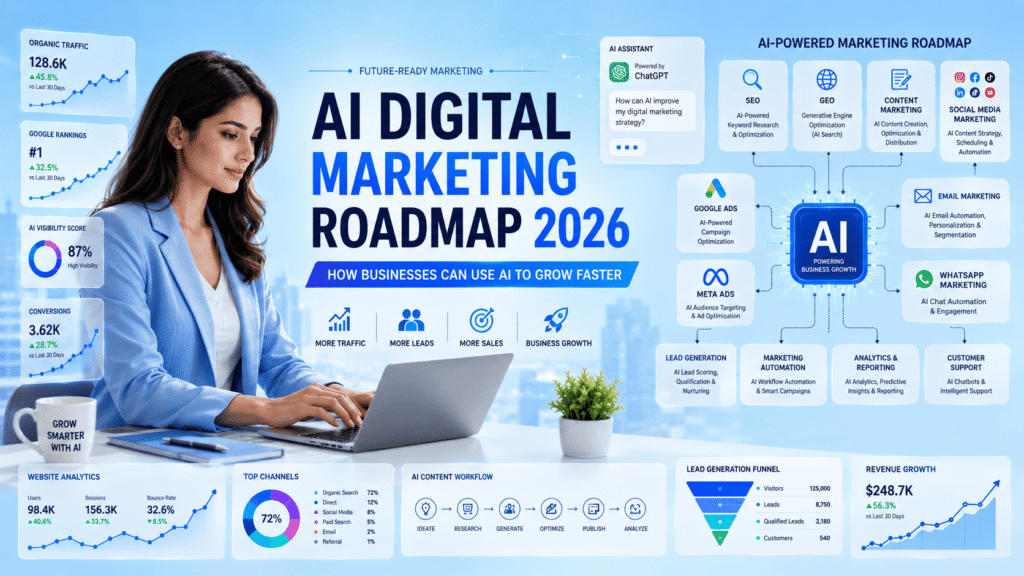
How Businesses Can Use AI for Digital Marketing in 2026: Complete Roadmap
Introduction
Artificial Intelligence is no longer a futuristic concept reserved for large corporations with massive budgets. In 2026, AI has become one of the most powerful tools available to businesses of all sizes. From startups and local businesses to e-commerce brands and global enterprises, companies are using AI to improve efficiency, create better marketing campaigns, generate more leads, and make smarter decisions.
The challenge is that many business owners know AI is important but don’t know where to start. They hear about ChatGPT, Google Gemini, AI-powered SEO tools, marketing automation platforms, and AI content creation software, but they often struggle to understand how these technologies fit into a practical digital marketing strategy.
This AI Digital Marketing Roadmap provides a complete guide to how businesses can use AI across every major digital marketing channel. Whether your goal is increasing organic traffic, generating more leads, improving customer engagement, or scaling your marketing efforts, this roadmap will help you understand exactly where AI can create the biggest impact.
What Is AI Digital Marketing?
AI digital marketing refers to the use of artificial intelligence technologies to improve marketing activities, automate repetitive tasks, analyze customer behavior, create content, optimize campaigns, and enhance decision-making.
Instead of replacing marketers, AI acts as a powerful assistant that helps businesses work faster and more efficiently.
Common applications include:
- SEO optimization
- Keyword research
- Blog writing assistance
- Social media content creation
- Advertising optimization
- Email marketing automation
- Customer support chatbots
- Lead generation
- Data analysis
The most successful businesses in 2026 are not replacing humans with AI. They are combining human creativity with AI efficiency.
Why AI Matters for Businesses in 2026
Consumer behavior has changed significantly.
Customers now interact with brands through:
- Google Search
- Google AI Overviews
- ChatGPT Search
- Gemini
- Perplexity
- Social media platforms
- Voice assistants
As competition increases, businesses need smarter ways to attract attention and convert visitors into customers.
AI helps businesses:
Save Time
Tasks that once required hours can often be completed in minutes.
Improve Productivity
Teams can focus on strategy while AI handles repetitive work.
Reduce Marketing Costs
Automation lowers operational expenses.
Improve Customer Experience
AI can deliver personalized experiences at scale.
Increase Marketing Performance
Data-driven insights lead to better campaigns and higher ROI.
Key Benefits of Using AI in Digital Marketing
Better Content Creation
AI helps generate blog ideas, outlines, social media posts, and marketing copy.
Faster Market Research
Businesses can analyze competitors and customer behavior more efficiently.
Improved SEO Performance
AI tools can identify keyword opportunities, content gaps, and optimization recommendations.
Smarter Advertising
AI helps optimize targeting, bidding strategies, and ad creatives.
Enhanced Lead Generation
Businesses can identify and nurture prospects more effectively.
Better Analytics
AI can uncover insights hidden within large datasets.
The Complete AI Digital Marketing Roadmap
Step 1: Use AI for Market Research
Every successful marketing campaign starts with understanding your audience.
AI tools can help businesses identify:
- Customer pain points
- Industry trends
- Competitor strategies
- Emerging opportunities
Recommended Tools:
- ChatGPT
- Gemini
- Perplexity
- Google Trends
Example:
A local digital marketing agency can use AI to discover that business owners are increasingly searching for “AI Search Optimization” and “Google AI Overviews SEO.” This insight can guide future content strategies.
Best Practice
Always validate AI-generated research using real-world data sources such as Google Trends and Search Console.
Step 2: Use AI for SEO
SEO remains one of the highest ROI marketing channels.
AI can significantly improve:
- Keyword research
- Content planning
- On-page SEO
- Technical SEO audits
- Competitor analysis
- GEO optimization
Recommended Tools:
- Ahrefs
- Semrush
- Surfer SEO
- ChatGPT
- Screaming Frog
AI can help identify content opportunities, optimize articles, and improve visibility across both traditional search engines and AI-powered search experiences.
Businesses that combine SEO and AI Search Optimization are better positioned to succeed in 2026.
Step 3: Use AI for Content Creation
Content remains the foundation of digital marketing.
AI can assist with:
- Blog writing
- Content briefs
- Email marketing
- Product descriptions
- Social media captions
- Video scripts
Recommended Tools:
- ChatGPT
- Claude
- Gemini
- Jasper
However, businesses should never publish AI-generated content without human review. The most effective content combines AI efficiency with human expertise and industry knowledge.
Step 4: Use AI for Social Media Marketing
Social media marketing has become increasingly competitive. Businesses need consistent content, creative ideas, audience engagement, and performance tracking.
AI can help simplify this process.
How AI Helps Social Media Marketing
- Generates content ideas
- Creates captions
- Suggests hashtags
- Plans content calendars
- Identifies trending topics
- Analyzes audience engagement
Recommended Tools
- ChatGPT
- Canva AI
- Predis AI
- Buffer AI Assistant
- Hootsuite AI
Practical Example
A small business owner can use ChatGPT to generate 30 Instagram post ideas in minutes instead of spending hours brainstorming content.
Expert Recommendation
Use AI for content planning and first drafts, but always add your brand voice, personal experiences, and industry expertise before publishing.
Step 5: Use AI for Video Marketing
Video content continues to dominate digital marketing.
Short-form videos on:
- Instagram Reels
- YouTube Shorts
- Facebook Reels
- TikTok
are generating massive engagement.
How AI Helps Video Marketing
- Script writing
- Video editing
- Voice generation
- Caption creation
- Thumbnail suggestions
- Content repurposing
Recommended Tools
- CapCut
- Descript
- Runway
- Pika
- InVideo AI
Practical Example
A marketing agency can convert a 2,000-word blog into multiple short-form videos using AI-powered editing tools.
Step 6: Use AI for Google Ads
Google Ads remains one of the fastest ways to generate leads and sales.
AI helps businesses improve:
- Keyword targeting
- Ad copy creation
- Campaign optimization
- Conversion tracking
- Landing page recommendations
Recommended Tools
- Google Ads AI
- ChatGPT
- Semrush
- Unbounce
Best Practice
Never rely entirely on AI-generated ads. Always review ad copy to ensure accuracy and compliance with Google Ads policies.
Step 7: Use AI for Meta Ads
Meta platforms continue to be powerful channels for businesses.
AI can improve:
- Audience targeting
- Ad creatives
- Campaign testing
- Performance optimization
Recommended Tools
- Meta Advantage+
- Canva AI
- ChatGPT
- AdCreative.ai
Example
An e-commerce brand can use AI to create multiple ad variations and test different messaging without increasing design costs.
Step 8: Use AI for Email Marketing
Email marketing remains one of the highest ROI digital marketing channels.
AI can help with:
- Subject line generation
- Email copywriting
- Audience segmentation
- Personalization
- Automation workflows
Recommended Tools
- Mailchimp AI
- HubSpot AI
- ChatGPT
- ActiveCampaign
Practical Example
Businesses can automatically personalize email campaigns based on customer interests and purchase behavior.
Step 9: Use AI for WhatsApp Marketing
WhatsApp marketing is becoming increasingly important for businesses.
AI helps with:
- Automated replies
- Customer support
- Lead qualification
- Follow-up sequences
- Appointment reminders
Recommended Tools
- WhatsApp Business
- WATI
- Interakt
- AiSensy
Benefits
- Faster response times
- Improved customer experience
- Better lead nurturing
Step 10: Use AI for Lead Generation
Generating qualified leads is one of the most important goals for any business.
AI can help identify prospects, score leads, and automate outreach.
Recommended Tools
- Apollo
- Clay
- HubSpot
- LinkedIn Sales Navigator
Example
A B2B company can use AI to identify decision-makers and create personalized outreach campaigns at scale.
Step 11: Use AI for Customer Support
Customers expect quick responses.
AI-powered chatbots can:
- Answer common questions
- Provide product information
- Book appointments
- Route support tickets
Recommended Tools
- ChatGPT-powered chatbots
- Intercom
- Drift
- Zendesk AI
Best Practice
Use AI to handle routine queries while allowing human agents to manage complex situations.
Step 12: Use AI for Analytics and Reporting
Data is one of the most valuable business assets.
AI helps businesses understand:
- Traffic trends
- User behavior
- Campaign performance
- Conversion patterns
Recommended Tools
- Google Analytics 4
- Looker Studio
- ChatGPT
- Microsoft Power BI
Practical Example
Instead of manually reviewing reports, businesses can use AI to summarize performance and identify actionable insights.
Best AI Tools by Marketing Channel
| Marketing Area | Recommended AI Tools |
|---|---|
| SEO | Ahrefs, Semrush, Surfer SEO, ChatGPT |
| Content Creation | ChatGPT, Claude, Gemini, Jasper |
| Social Media | Predis AI, Canva AI, Buffer |
| Video Marketing | CapCut, Runway, Descript |
| Google Ads | Google Ads AI, Semrush |
| Meta Ads | Meta Advantage+, AdCreative.ai |
| Email Marketing | Mailchimp AI, HubSpot AI |
| WhatsApp Marketing | WATI, Interakt, AiSensy |
| Lead Generation | Apollo, Clay |
| Analytics | GA4, Looker Studio |
Real-World Business Example
Imagine a local digital marketing agency that previously relied entirely on manual processes.
The team spent:
- 10 hours weekly creating social media content
- 8 hours researching keywords
- 6 hours writing blog outlines
- 5 hours preparing reports
After implementing AI tools:
Before AI
- Slow content production
- Limited campaign testing
- Manual reporting
- Delayed customer responses
After AI
- Faster content creation
- Better keyword research
- Automated reporting
- Improved customer support
- More time for strategy and client management
Within six months, the agency increased content output, improved campaign performance, and reduced repetitive workloads significantly.
This demonstrates how businesses can use AI to improve efficiency while maintaining quality.
Common Mistakes Businesses Make with AI
Many businesses adopt AI incorrectly.
1. Publishing AI Content Without Human Review
Why It Happens
Businesses want faster content production.
Impact
Content may contain inaccuracies, weak examples, or generic advice.
Solution
Always review, edit, fact-check, and add human expertise.
2. Using AI Without a Strategy
Why It Happens
Businesses chase AI trends without clear goals.
Impact
Poor ROI and wasted effort.
Solution
Create an AI marketing roadmap aligned with business objectives.
3. Ignoring SEO Fundamentals
Why It Happens
Businesses assume AI replaces SEO.
Impact
Reduced visibility in search engines.
Solution
Combine AI tools with strong SEO practices.
4. Relying on One AI Tool
Why It Happens
Businesses become dependent on a single platform.
Impact
Limited results.
Solution
Use specialized tools for SEO, content, analytics, advertising, and automation.
5. Creating Generic Content
Why It Happens
Businesses publish AI output without customization.
Impact
Low engagement and poor rankings.
Solution
Add personal experience, case studies, and original insights.
6. Ignoring Analytics
Why It Happens
Businesses focus on content production but not performance.
Impact
Missed optimization opportunities.
Solution
Track KPIs using GA4, Search Console, and reporting tools.
7. Forgetting Customer Experience
Why It Happens
Businesses focus only on automation.
Impact
Poor customer satisfaction.
Solution
Balance automation with human interaction.
Expert Tips for Faster Results
Focus on One Channel First
Master AI for one marketing channel before expanding.
Combine AI with Human Expertise
The best results come from collaboration between humans and AI.
Use AI for Research and Efficiency
Use AI to save time, not replace strategic thinking.
Build Content Clusters
Create interconnected content around major topics.
Monitor AI Search Trends
Pay attention to Google AI Overviews, ChatGPT Search, Gemini, and Perplexity.
Future Trends in AI Digital Marketing
Businesses should prepare for:
AI Search Optimization (GEO)
Traditional SEO will increasingly evolve toward AI search visibility.
Personalized Marketing at Scale
AI will deliver highly customized experiences.
Predictive Analytics
Businesses will anticipate customer needs before they arise.
Advanced Marketing Automation
AI will manage larger portions of marketing workflows.
AI-Powered Customer Experiences
Chatbots and virtual assistants will become more sophisticated.
Organizations that adopt these trends early will gain a competitive advantage.
Digital Marketing Roadmap Success Checklist
Before implementing any strategy, businesses should create a clear Digital Marketing Roadmap that aligns with their goals. A successful Digital Marketing Roadmap combines SEO, content marketing, paid advertising, social media management, email marketing, and AI-powered automation. Companies that regularly review their Digital Marketing Roadmap can identify growth opportunities, improve customer engagement, and increase conversions. As technology evolves, updating your Digital Marketing Roadmap ensures your business remains competitive and visible across search engines, AI platforms, and social media channels. Whether you are a startup or an established brand, following a structured Digital Marketing Roadmap can help you achieve sustainable long-term growth.
Conclusion
Artificial Intelligence is transforming digital marketing faster than any technology in recent history.
Businesses that embrace AI can improve productivity, reduce costs, generate better content, create more effective advertising campaigns, and provide better customer experiences.
However, AI is not a replacement for human expertise.
The most successful businesses in 2026 will combine:
- Human creativity
- Strategic thinking
- Industry expertise
- AI-powered efficiency
Start by implementing AI in one area of your marketing, measure results, refine your processes, and gradually expand your AI capabilities.
The businesses that learn to work alongside AI today will be the market leaders of tomorrow.
FAQs
1. What is AI digital marketing?
AI digital marketing is the use of artificial intelligence technologies to improve marketing activities such as SEO, content creation, advertising, lead generation, customer support, and analytics.
2. Can AI replace digital marketers?
No. AI can automate repetitive tasks and improve efficiency, but human creativity, strategic thinking, and decision-making remain essential.
3. What is the best AI tool for digital marketing?
There is no single best tool. Businesses often use a combination of ChatGPT, Semrush, Ahrefs, Canva AI, HubSpot AI, and Google Analytics depending on their goals.
4. How can small businesses use AI?
Small businesses can use AI for content creation, social media marketing, SEO, email marketing, customer support, and lead generation without requiring large budgets.
5. Is AI useful for SEO?
Yes. AI can help with keyword research, content planning, competitor analysis, technical SEO audits, and AI search optimization strategies.
6. What is GEO in digital marketing?
Generative Engine Optimization (GEO) focuses on improving visibility in AI-powered search platforms such as ChatGPT Search, Google AI Overviews, Gemini, and Perplexity.
7. How should businesses start using AI?
Begin with one area such as content creation or SEO, learn how AI fits into existing workflows, measure performance, and gradually expand usage across other marketing channels.
Why Every Business Needs a Digital Marketing Roadmap in 2026
In today’s competitive online environment, having a clear Digital Marketing Roadmap is no longer optional. Businesses that follow a structured Digital Marketing Roadmap can make better decisions about SEO, content marketing, social media marketing, paid advertising, email campaigns, and AI-powered automation. A well-planned Digital Marketing Roadmap helps companies allocate budgets effectively, improve customer engagement, generate qualified leads, and achieve long-term growth. As AI tools continue to transform marketing strategies, businesses that regularly update their Digital Marketing Roadmap will be better positioned to adapt to market changes, improve online visibility, and outperform competitors. Whether you are a startup, local business, or established brand, implementing a strong Digital Marketing Roadmap can significantly improve your marketing performance and return on investment.
How to Rank in Google AI Search- https://socialdigimarq.com/how-to-rank-in-google-ai-search/
SEO Services- https://socialdigimarq.com/seo/
Digital Marketing Services link- Services
To stay ahead in 2026, businesses should combine AI-powered marketing with strong SEO fundamentals and data-driven decision making. If you want to improve your visibility in AI-powered search engines, read our guide on How to Rank in Google AI Search. You can also explore our SEO Services and Digital Marketing Services to build a stronger online presence.
For further learning, businesses can follow resources from Google Search Central, Google Trends, and OpenAI to stay updated with the latest developments in SEO, AI search, and digital marketing.
Google Search Central –https://developers.google.com/search