
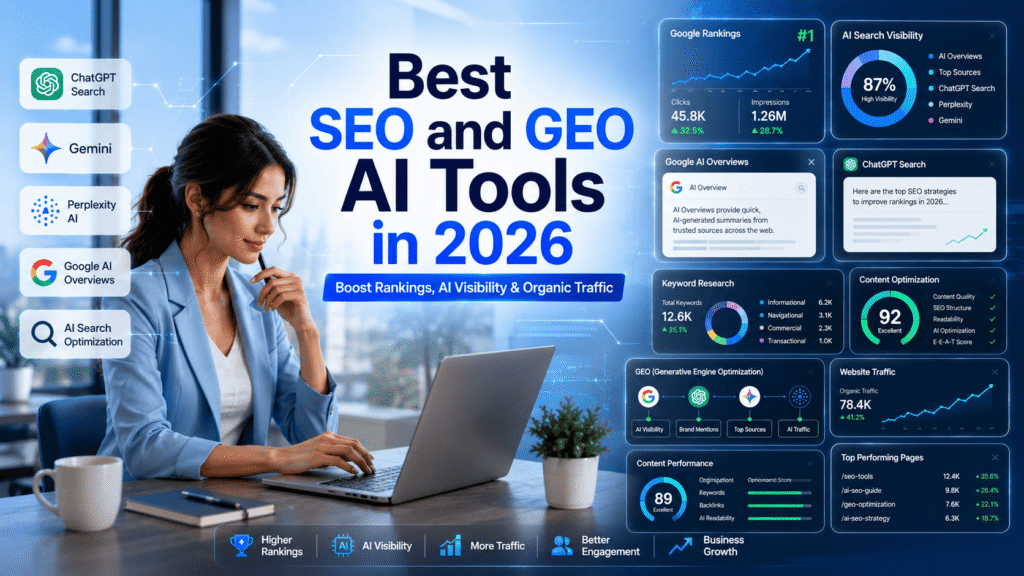
Best SEO and GEO AI Tools in 2026: Complete Guide
Introduction
Search engine optimization is changing faster than ever. For years, businesses focused primarily on ranking on traditional search engines such as Google and Bing. However, the rise of AI-powered search experiences, including Google AI Overviews, ChatGPT Search, Gemini, and Perplexity, has created an entirely new challenge: how to remain visible when AI systems generate answers directly for users.
This shift has led to the growing importance of SEO and GEO AI Tools.
Traditional SEO helps websites rank in search engine results pages, while Generative Engine Optimization (GEO) focuses on improving visibility within AI-generated answers and conversational search experiences. Businesses that understand both disciplines are gaining a significant competitive advantage.
Whether you are a business owner, marketer, freelancer, startup founder, or agency professional, understanding the best SEO and GEO AI Tools can help improve search visibility, increase organic traffic, strengthen brand authority, and generate more qualified leads.
In this guide, we will explore the most effective SEO and GEO AI Tools available in 2026, how they work, and how businesses can use them to build sustainable online growth.
What Are SEO and GEO AI Tools?
SEO and GEO AI Tools are software platforms designed to improve a website’s visibility across both traditional search engines and AI-powered search environments.
SEO Tools
SEO tools focus on:
- Keyword research
- Technical SEO audits
- Competitor analysis
- Content optimization
- Backlink analysis
- Rank tracking
Examples include:
- Ahrefs
- Semrush
- Google Search Console
- Screaming Frog
GEO Tools
GEO tools focus on:
- AI search visibility
- AI citation monitoring
- Content entity optimization
- Conversational search optimization
- AI Overview visibility
- Knowledge graph enhancement
Examples include:
- Profound
- Peec AI
- Otterly AI
- Goodie AI
As AI search becomes more popular, businesses need both SEO and GEO strategies to maintain visibility.
Why SEO and GEO AI Tools Matter in 2026
Many marketers are still optimizing only for Google rankings.
The problem is that user behavior is changing.
People now search using:
- ChatGPT
- Gemini
- Perplexity
- Microsoft Copilot
- Google AI Overviews
Instead of clicking multiple search results, users increasingly receive direct AI-generated answers.
This means businesses must optimize for:
Traditional Search Visibility
Ranking on Google Search results.
AI Search Visibility
Being referenced and cited by AI systems.
Entity Recognition
Helping AI understand your brand, products, services, and expertise.
Content Authority
Building trust through comprehensive and authoritative content.
SEO and GEO AI Tools help marketers measure and improve performance across these new search environments.
SEO vs GEO: Understanding the Difference
| SEO | GEO |
|---|---|
| Optimizes for search engines | Optimizes for AI engines |
| Focuses on rankings | Focuses on AI citations |
| Uses keywords | Uses entities and context |
| Targets search results | Targets AI-generated answers |
| Measures organic traffic | Measures AI visibility |
Businesses that combine SEO and GEO strategies gain the best results because they capture both traditional and AI-driven traffic.
Key Benefits of SEO and GEO AI Tools
Improved Search Visibility
These tools help businesses appear in more places across the internet.
Better Content Optimization
AI tools identify content gaps and opportunities.
Stronger Competitive Analysis
Businesses can discover what competitors are doing successfully.
Higher Organic Traffic
Better optimization leads to more qualified visitors.
Enhanced AI Search Presence
GEO tools improve visibility in AI-generated search experiences.
More Efficient Workflows
Automation reduces time spent on repetitive SEO tasks.
Best SEO AI Tools in 2026
1. Ahrefs
Ahrefs remains one of the most powerful SEO platforms available.
Best For:
- Keyword research
- Backlink analysis
- Competitor research
Key Features:
- Site Explorer
- Keywords Explorer
- Content Gap Analysis
- Rank Tracking
Pros:
- Excellent backlink database
- Accurate keyword data
- Strong competitor insights
Cons:
- Higher pricing for small businesses
2. Semrush
Semrush provides a complete digital marketing toolkit.
Best For:
- SEO
- PPC
- Content Marketing
- Competitor Analysis
Key Features:
- Keyword Magic Tool
- Site Audit
- Position Tracking
- Backlink Analytics
Pros:
- Comprehensive platform
- Strong reporting features
- Excellent keyword research
Cons:
- Learning curve for beginners
3. Google Search Console
Google Search Console remains one of the most important free SEO tools.
Best For:
- Monitoring search performance
- Indexing issues
- Technical SEO
Key Features:
- Search Analytics
- Index Coverage
- Core Web Vitals
- URL Inspection
Pros:
- Free
- Direct Google data
- Essential for every website
Cons:
- Limited competitor insights
4. Screaming Frog
Screaming Frog helps identify technical SEO issues.
Best For:
- Technical SEO audits
- Website crawling
- Broken link analysis
Key Features:
- Crawl reports
- Redirect analysis
- Duplicate content detection
- Metadata audits
Pros:
- Detailed technical insights
- Affordable pricing
Cons:
- Requires technical understanding
5. Surfer SEO
Surfer SEO focuses on content optimization.
Best For:
- Content creation
- On-page SEO
Key Features:
- Content Score
- NLP recommendations
- Competitor content analysis
Pros:
- Easy content optimization
- Helpful content recommendations
Cons:
- Limited technical SEO functionality
Internal Link Suggestions
- How to Rank in Google AI Search
https://socialdigimarq.com/how-to-rank-in-google-ai-search/ - Best AI Tools for Social Media Marketing
https://socialdigimarq.com/ - Instagram Growth Strategy in 2026
https://socialdigimarq.com/ - Google AI Overviews Guide
https://socialdigimarq.com/ - YouTube Shorts vs Instagram Reels
https://socialdigimarq.com/
External Link Suggestions
- Google Search Central
https://developers.google.com/search - Google Trends
https://trends.google.com - OpenAI
https://openai.com - Google Business Profile Help
https://support.google.com/business - Google Ads Help Center
https://support.google.com/google-ads - Meta Business Help Center
https://www.facebook.com/business/help