
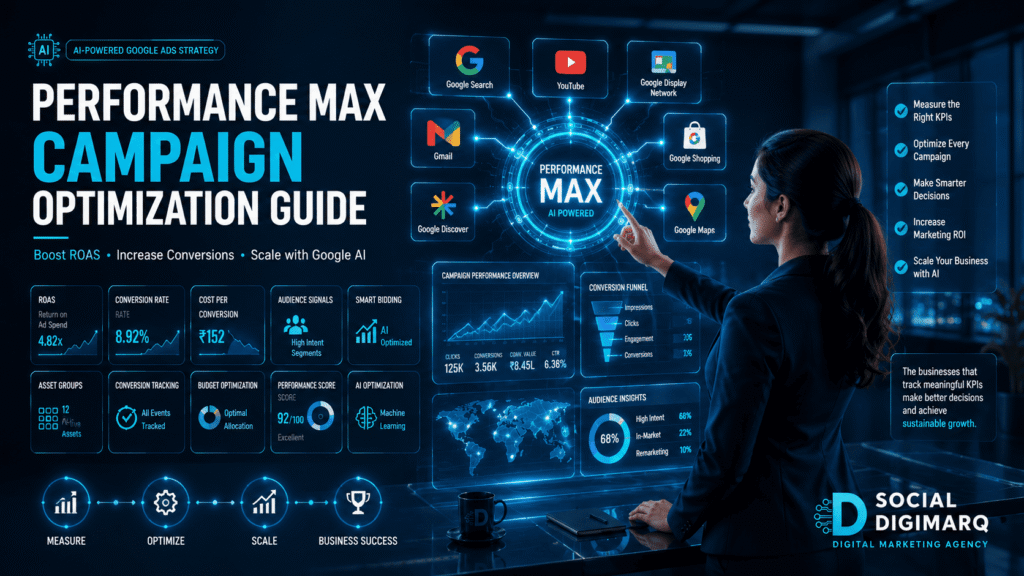
Performance Max Campaign Optimization Guide: Boost Google Ads Performance in 2026
Running Google Ads successfully in 2026 is no longer just about choosing the right keywords. With Google’s AI becoming more advanced, advertisers need smarter campaign strategies that maximize conversions across every Google platform. This is where a Performance Max Campaign Optimization Guide becomes essential.
Performance Max (PMax) is Google’s AI-powered campaign type that allows advertisers to reach potential customers across Search, YouTube, Display, Discover, Gmail, Maps, and the Google Display Network—all from a single campaign. Instead of managing multiple campaign types separately, Performance Max uses machine learning to automatically optimize bidding, placements, audiences, and creatives.
However, many businesses make the mistake of launching a Performance Max campaign and expecting Google’s AI to handle everything. Without proper optimization, campaigns can waste budget, attract low-quality traffic, and deliver poor return on ad spend (ROAS).
This Performance Max Campaign Optimization Guide will help you understand how Performance Max works, why it matters in 2026, and how to optimize every part of your campaign—from audience signals and asset groups to bidding strategies and conversion tracking.
Whether you’re a business owner, digital marketer, freelancer, or agency, this guide will help you build high-performing Google Ads campaigns that generate more qualified leads and sales.
What Is a Performance Max Campaign?
A Performance Max campaign is an AI-driven Google Ads campaign that uses automation to show your ads across all Google channels from one centralized campaign.
Instead of creating separate campaigns for Search, Display, YouTube, Gmail, and Discover, Performance Max combines them into one campaign powered by Google’s machine learning.
Your ads can appear on:
- Google Search
- YouTube
- Gmail
- Google Discover
- Google Maps
- Google Display Network
- Google Shopping (for eligible businesses)
Google’s AI determines:
- Which audience should see your ads
- Which platform performs best
- Which creative combination generates higher conversions
- The best bidding strategy
- The best time and location to show ads
The main goal is to maximize conversions while using automation to improve campaign performance.
Why Performance Max Matters in 2026
Google continues to invest heavily in artificial intelligence, making automation a core part of digital advertising.
Several reasons explain why Performance Max has become one of the most important Google Ads campaign types.
1. AI-Driven Optimization
Performance Max continuously analyzes millions of data points in real time.
It automatically adjusts:
- Bids
- Placements
- Audience targeting
- Device selection
- Ad combinations
This allows advertisers to reach customers more efficiently than traditional manual campaigns.
2. Reach Across Google’s Entire Ecosystem
Instead of limiting campaigns to Search or Display, Performance Max expands your reach across every major Google platform.
This creates more opportunities to engage customers at different stages of the buying journey.
3. Better Conversion Opportunities
Google’s AI identifies users who are most likely to convert based on:
- Search intent
- Browsing behavior
- Purchase history
- Device usage
- Location
- Time of day
- Audience signals
As a result, advertisers can often achieve higher conversion rates while reducing manual campaign management.
4. Improved Budget Allocation
Rather than splitting your advertising budget across multiple campaigns, Performance Max dynamically shifts spend toward the highest-performing placements.
For example:
- If YouTube delivers more conversions, Google allocates more budget there.
- If Search performs better, spending automatically shifts toward Search traffic.
This flexibility helps maximize campaign efficiency.
How Does Performance Max Work?
Performance Max uses artificial intelligence and machine learning to automate campaign management.
Advertisers provide Google with:
- Marketing objective
- Budget
- Conversion goals
- Images
- Headlines
- Descriptions
- Videos (recommended)
- Audience signals
Google’s AI then creates thousands of possible ad combinations and serves the best-performing versions across its advertising network.
As more conversion data becomes available, the algorithm continues learning and improving campaign performance.
Key Components of a Performance Max Campaign
Understanding each component is the first step in any Performance Max Campaign Optimization Guide.
1. Asset Groups
Asset Groups function similarly to ad groups but contain creative assets instead of keywords.
Each Asset Group includes:
- Headlines
- Long Headlines
- Descriptions
- Images
- Logos
- Videos
- Final URL
- Audience Signals
Google automatically combines these assets to create the most effective ad variations.
2. Audience Signals
Audience Signals help Google’s AI learn faster during the campaign’s initial learning phase.
Examples include:
- Customer Match Lists
- Website Visitors
- Custom Segments
- In-Market Audiences
- Affinity Audiences
Although Google can expand beyond these audiences, providing strong audience signals often improves early campaign performance.
3. Conversion Goals
Performance Max is designed around conversions.
Common conversion goals include:
- Lead Form Submissions
- Phone Calls
- Purchases
- Newsletter Sign-ups
- Appointment Bookings
- Store Visits
Accurate conversion tracking is critical because Google’s AI optimizes based on these signals.
4. Bidding Strategy
Performance Max supports several Smart Bidding options:
- Maximize Conversions
- Maximize Conversion Value
- Target CPA (Cost Per Acquisition)
- Target ROAS (Return on Ad Spend)
Choosing the correct bidding strategy depends on your business goals and available conversion data.
Benefits of Performance Max Campaigns
Businesses adopting Performance Max can experience several advantages when campaigns are properly optimized.
Higher Reach
One campaign reaches users across Google’s entire advertising ecosystem.
Smarter Automation
Google continuously tests and improves campaign performance without requiring constant manual adjustments.
Better Efficiency
AI reduces repetitive campaign management tasks while improving optimization speed.
Increased Conversion Potential
Machine learning identifies high-intent users more effectively than manual targeting alone.
Real-Time Learning
Performance improves continuously as Google collects more conversion data.
Who Should Use Performance Max?
Performance Max works well for:
- Local Businesses
- E-commerce Stores
- Service-Based Businesses
- Lead Generation Campaigns
- Marketing Agencies
- Freelancers Managing Client Accounts
- Brands with Strong Creative Assets
Businesses that already have reliable conversion tracking and quality creative assets typically achieve the best results.
Step-by-Step Performance Max Campaign Optimization Guide
A successful Performance Max Campaign Optimization Guide starts with proper campaign setup. Google’s AI is powerful, but it performs best when advertisers provide high-quality data, creative assets, and clear conversion goals.
Follow these proven optimization steps to improve campaign performance and maximize your return on ad spend (ROAS).
Step 1: Set Up Accurate Conversion Tracking
Before launching a Performance Max campaign, ensure that your conversion tracking is working correctly. Google’s AI relies on conversion data to optimize bidding and audience targeting.
Track conversions such as:
- Lead Form Submissions
- Phone Calls
- Online Purchases
- Appointment Bookings
- Newsletter Sign-ups
- Store Visits
Without accurate conversion tracking, Google’s AI cannot optimize your campaign effectively.
Step 2: Build Strong Audience Signals
Audience Signals help Google’s machine learning identify potential customers faster during the learning phase.
Recommended Audience Signals include:
- Customer Match Lists
- Website Visitors
- Cart Abandoners
- Previous Buyers
- Custom Segments
- In-Market Audiences
- Affinity Audiences
Although Performance Max can expand beyond these audiences, providing high-quality signals improves campaign performance significantly.
Step 3: Create High-Quality Asset Groups
Asset Groups are the foundation of every Performance Max campaign.
Each Asset Group should focus on one product, service, or business category.
Include:
Headlines
Write multiple keyword-rich headlines highlighting your products or services.
Example:
- Digital Marketing Services
- Google Ads Experts
- Increase Your Online Sales
- SEO & PPC Specialists
- Grow Your Business Faster
Long Headlines
Use longer headlines that explain your value proposition.
Example:
- Grow Your Business with Professional Google Ads Management
- Performance Marketing Solutions That Deliver More Leads
Descriptions
Write clear and benefit-focused descriptions.
Highlight:
- Experience
- Results
- Trust
- Unique Selling Points
- Call-to-Action
Step 4: Upload High-Quality Images
Performance Max automatically serves visual ads across multiple Google platforms.
Recommended image sizes include:
- Square Images
- Landscape Images
- Portrait Images
Best practices:
- Use high-resolution images
- Showcase your products or services
- Maintain consistent branding
- Avoid excessive text
- Use professional visuals
Step 5: Add Videos
Google recommends including videos in every Performance Max campaign.
If no video is uploaded, Google may automatically generate one, which may not match your brand identity.
Create videos that:
- Introduce your business
- Demonstrate products
- Highlight customer benefits
- Explain your services
- Include a clear call-to-action
Short videos between 15 and 30 seconds often perform well.
Step 6: Choose the Right Bidding Strategy
Selecting the appropriate bidding strategy is one of the most important steps in any Performance Max Campaign Optimization Guide.
Common Smart Bidding options include:
Maximize Conversions
Best for businesses focused on generating more leads or sales.
Maximize Conversion Value
Ideal for e-commerce businesses aiming to maximize total revenue.
Target CPA
Suitable when you have sufficient historical conversion data and want to control your average cost per acquisition.
Target ROAS
Best for businesses with revenue tracking that want to maximize return on ad spend.
Step 7: Optimize Your Budget
Avoid making large budget changes during the campaign’s learning phase.
Best practices:
- Allow the campaign to run for at least 2–3 weeks before making major changes.
- Increase budgets gradually.
- Allocate sufficient daily budget to generate meaningful conversion data.
Consistent budgets help Google’s AI learn more effectively.
Step 8: Improve Landing Pages
Even the best campaign cannot succeed if the landing page performs poorly.
Optimize your landing pages by:
- Improving page speed
- Ensuring mobile responsiveness
- Using clear headlines
- Adding strong call-to-action buttons
- Displaying trust signals
- Including testimonials and reviews
- Simplifying lead forms
A better landing page often results in higher conversion rates.
Step 9: Use High-Quality First-Party Data
Google increasingly relies on first-party data for campaign optimization.
Examples include:
- Customer Email Lists
- Previous Purchasers
- CRM Data
- Loyalty Program Members
- Repeat Customers
This data helps Google’s AI identify similar high-value audiences.
Step 10: Allow the Learning Phase to Complete
Many advertisers make changes too quickly.
Performance Max typically requires several weeks to gather enough data and optimize effectively.
Avoid:
- Frequent budget changes
- Constant asset modifications
- Daily bid adjustments
- Restarting campaigns unnecessarily
Patience often leads to better long-term performance.
Common Performance Max Optimization Mistakes
Avoid these mistakes:
- Launching campaigns without conversion tracking
- Using low-quality images
- Ignoring audience signals
- Providing only a few headlines
- Sending traffic to poor landing pages
- Making frequent budget changes
- Stopping campaigns too early
- Ignoring asset performance insights
- Using generic ad copy
- Not reviewing search term insights
Avoiding these issues can significantly improve campaign results.
Key Takeaways
- Set up accurate conversion tracking before launching.
- Build strong audience signals.
- Create high-quality asset groups.
- Upload professional images and videos.
- Choose the correct Smart Bidding strategy.
- Optimize landing pages for conversions.
- Use first-party customer data whenever possible.
- Give Google’s AI enough time to learn and optimize.
Advanced Performance Max Campaign Optimization Techniques
Once your campaign has completed its learning phase, it’s time to focus on advanced optimization strategies. These techniques can help improve ROAS, increase conversions, and reduce wasted ad spend.
1. Optimize Asset Group Performance
Asset Groups are the core of every Performance Max campaign. Regularly review asset performance and replace low-performing creatives.
Best Practices
- Group similar products or services together.
- Create separate Asset Groups for different customer segments.
- Add fresh headlines and descriptions regularly.
- Test multiple images and videos.
- Highlight unique selling points (USPs).
The more high-quality assets you provide, the more combinations Google’s AI can test and optimize.
2. Improve Creative Assets Regularly
Ad fatigue can reduce campaign performance over time.
Refresh your creative assets every few weeks by updating:
- Headlines
- Long Headlines
- Descriptions
- Images
- Videos
- Call-to-Action messages
Seasonal promotions, offers, and new product visuals can help maintain strong engagement.
3. Optimize Audience Signals
Although Google expands beyond your Audience Signals, they still play an important role in guiding the algorithm.
Update Audience Signals by adding:
- Recent Website Visitors
- Existing Customers
- High-Value Customers
- Previous Converters
- Cart Abandoners
- Custom Intent Audiences
Regular updates help Google’s AI discover more qualified users.
4. Use Search Themes (When Available)
Search Themes provide Google with additional context about the types of searches most relevant to your business.
Examples:
- Digital Marketing Agency
- Google Ads Services
- SEO Company
- PPC Management
- Lead Generation Agency
These themes help Google’s AI understand your business goals more effectively.
5. Monitor Asset Performance
Google classifies assets into categories such as:
- Best
- Good
- Low
- Learning
Replace low-performing assets with stronger alternatives.
Continue testing new headlines, images, and videos to improve overall campaign performance.
6. Optimize Landing Pages
Your landing page directly affects conversion rates.
Improve your landing pages by:
- Increasing page speed
- Reducing loading time
- Writing compelling headlines
- Using clear CTA buttons
- Displaying customer testimonials
- Adding trust badges
- Simplifying forms
- Improving mobile responsiveness
A well-optimized landing page often leads to lower cost per conversion.
7. Monitor Key Performance Metrics
Review your campaign performance regularly.
Important metrics include:
- Impressions
- Clicks
- Click-Through Rate (CTR)
- Cost Per Click (CPC)
- Conversions
- Conversion Rate
- Cost Per Conversion
- Conversion Value
- ROAS
- Impression Share
These metrics help identify areas that need improvement.
8. Improve ROAS
If your Return on Ad Spend (ROAS) is lower than expected:
- Improve ad creatives.
- Use stronger Audience Signals.
- Optimize landing pages.
- Increase conversion rates.
- Remove low-performing assets.
- Test different bidding strategies.
- Improve product or service pages.
Small improvements across multiple areas can significantly increase profitability.
9. Scale Successful Campaigns
Once your campaign consistently generates profitable conversions:
- Increase budgets gradually.
- Expand into new geographic locations.
- Add new Asset Groups.
- Test additional products or services.
- Introduce new promotional offers.
Avoid making large budget increases overnight, as this can disrupt the learning process.
10. Avoid Common Optimization Mistakes
Many advertisers reduce campaign performance by making unnecessary changes.
Avoid:
- Editing campaigns every day.
- Pausing campaigns during the learning phase.
- Uploading poor-quality images.
- Using weak headlines.
- Ignoring conversion tracking.
- Sending traffic to slow landing pages.
- Making drastic budget changes.
- Focusing only on clicks instead of conversions.
Expert Best Practices for 2026
To maximize campaign performance:
- Use high-quality first-party customer data.
- Upload professional videos instead of relying on auto-generated videos.
- Refresh creative assets regularly.
- Monitor campaign insights weekly.
- Test new headlines and descriptions.
- Focus on conversion quality rather than click volume.
- Review search themes and audience signals monthly.
- Continuously improve landing page experience.
Real-World Example
A local home services company launched a Performance Max campaign with:
- Accurate conversion tracking
- High-quality images
- Custom videos
- Strong Audience Signals
- Optimized landing pages
Within three months, they achieved:
- 42% increase in qualified leads
- 31% lower Cost Per Conversion
- 54% higher ROAS
- Improved lead quality
- Better campaign scalability
This demonstrates how following a structured Performance Max Campaign Optimization Guide can produce measurable business results.
Key Takeaways
- Review Asset Group performance regularly.
- Refresh creative assets to prevent ad fatigue.
- Strengthen Audience Signals with first-party data.
- Monitor ROAS and conversion metrics.
- Improve landing page experience.
- Scale campaigns gradually after achieving consistent results.
- Focus on long-term optimization rather than frequent changes.
Recommended Links
Google AI Search Guide
How to Rank in Google AI Search
AI SEO Strategy
AI SEO Strategy in 2026
Google AI Overviews
How Businesses Can Rank in Google AI Overviews
Best AI Tools for Meta Ads
Best AI Tools for Meta Ads Lead Generation
Best AI Video Editing Tools
Best AI Video Editing Tools in 2026
Link Suggestions
Use authoritative sources to improve EEAT and provide additional value to readers.
- Google Ads Help: https://support.google.com/google-ads
- Google Ads Performance Max Documentation: https://support.google.com/google-ads/answer/10724817
- Google Search Central: https://developers.google.com/search
- Google Analytics: https://analytics.google.com
- http://Google Skillshop: https://skillshop.withgoogle.com
- Think with Google: https://www.thinkwithgoogle.com
Conclusion
A successful Performance Max Campaign Optimization Guide is more than simply launching an AI-powered campaign. True success comes from combining Google’s automation with smart strategy, high-quality creative assets, accurate conversion tracking, and continuous optimization.
Performance Max enables businesses to reach potential customers across Google Search, YouTube, Display, Discover, Gmail, Maps, and Shopping from a single campaign. However, the platform performs best when advertisers provide strong audience signals, compelling creatives, optimized landing pages, and reliable conversion data.
Whether you run a local business, eCommerce store, or digital marketing agency, following this Performance Max Campaign Optimization Guide will help you improve campaign efficiency, increase conversions, reduce wasted ad spend, and maximize your return on ad spend (ROAS).
As Google’s AI continues to evolve, advertisers who regularly test creatives, monitor campaign insights, refine audience signals, and improve landing page experiences will gain a competitive advantage in 2026 and beyond.
Frequently Asked Questions (FAQs)
What is a Performance Max Campaign?
Performance Max is Google’s AI-powered campaign type that allows advertisers to run ads across Search, YouTube, Display, Discover, Gmail, Maps, and Shopping using one campaign.
Is Performance Max better than Search Campaigns?
Performance Max works well for businesses seeking broad reach and AI-driven optimization. Search Campaigns are often better for advertisers targeting specific keywords with greater control. Many businesses use both together for the best results.
How long does a Performance Max campaign take to optimize?
Most campaigns require approximately two to four weeks to complete the learning phase. Avoid making frequent changes during this period.
Which bidding strategy is best for Performance Max?
The best strategy depends on your objectives.
- Maximize Conversions for lead generation.
- Maximize Conversion Value for revenue growth.
- Target CPA for controlling acquisition costs.
- Target ROAS for maximizing return on ad spend.
How often should I optimize my Performance Max campaign?
Review campaign performance weekly. Refresh creative assets monthly and make data-driven optimizations instead of frequent daily edits.
Does Performance Max require videos?
Videos are highly recommended. If you don’t upload one, Google may automatically generate a video using your available assets, which may not align with your branding.
Can local businesses use Performance Max?
Yes. Performance Max works well for local businesses by promoting products or services across multiple Google platforms and driving calls, leads, store visits, and website conversions.
What are Audience Signals in Performance Max?
Audience Signals are data sources such as customer lists, website visitors, and custom segments that help Google’s AI identify potential customers more quickly during the learning phase.
A well-planned Performance Max Campaign Optimization Guide helps businesses maximize the effectiveness of Google’s AI-powered advertising platform. By following this Performance Max Campaign Optimization Guide, advertisers can improve audience targeting, optimize Asset Groups, enhance conversion tracking, strengthen bidding strategies, and increase return on ad spend. As Google Ads continues to evolve in 2026, implementing a comprehensive Performance Max Campaign Optimization Guide will enable businesses to generate more qualified leads, improve campaign performance, and achieve sustainable long-term growth.