
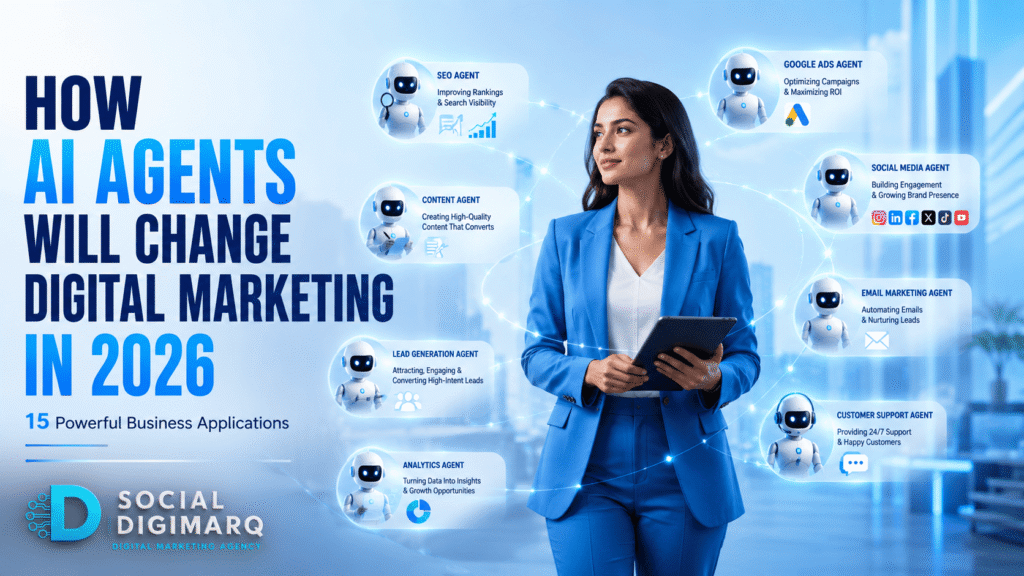
How AI Agents Will Change Digital Marketing in 2026: 15 Powerful Business Applications
Introduction
Artificial Intelligence has already transformed the digital marketing industry, but a new evolution is beginning to reshape how businesses attract customers, generate leads, and manage marketing campaigns. That evolution is AI Agents.
When discussing How AI Agents Will Change Digital Marketing in 2026, many business owners imagine simple chatbots or automation tools. However, AI Agents are far more advanced. They can analyze data, make decisions, perform tasks, optimize campaigns, communicate with customers, and continuously improve performance with minimal human intervention.
As businesses face increasing competition, rising advertising costs, and growing customer expectations, understanding How AI Agents Will Change Digital Marketing in 2026 has become essential for marketers, agencies, startups, entrepreneurs, and local businesses.
Companies that successfully implement AI Agents will gain a significant advantage through better efficiency, faster execution, improved customer experiences, and smarter decision-making.
In this guide, you’ll learn exactly How AI Agents Will Change Digital Marketing in 2026, why they matter, and how businesses can prepare for the next generation of AI-powered marketing.
What Are AI Agents?
AI Agents are intelligent software systems designed to perform tasks autonomously.
Unlike traditional AI tools that require constant prompts and supervision, AI Agents can:
- Analyze information
- Make decisions
- Execute tasks
- Learn from outcomes
- Improve performance over time
Think of an AI Agent as a digital employee working alongside your marketing team.
For example:
A traditional AI tool might write a blog when instructed.
An AI Agent can:
- Research keywords
- Analyze competitors
- Create an outline
- Write the article
- Optimize it for SEO
- Schedule publication
- Monitor rankings
with minimal human input.
This ability is one reason How AI Agents Will Change Digital Marketing in 2026 is becoming one of the most discussed topics in the marketing industry.
How AI Agents Differ from Traditional AI Tools
Many marketers confuse AI Agents with standard AI software.
There are important differences.
| Traditional AI Tools | AI Agents |
|---|---|
| Require prompts | Can act independently |
| Complete single tasks | Manage entire workflows |
| Limited automation | Advanced automation |
| Human-led execution | Autonomous execution |
| Reactive | Proactive |
Example
ChatGPT may help write an article.
An AI Agent could:
- Find keyword opportunities.
- Create content.
- Publish the content.
- Track rankings.
- Suggest updates.
without needing repeated instructions.
This level of autonomy is why businesses are paying close attention to How AI Agents Will Change Digital Marketing in 2026.
Why AI Agents Matter in 2026
Several major trends are driving adoption.
Growing Marketing Complexity
Modern marketing includes:
- SEO
- AI Search Optimization
- Google Ads
- Meta Ads
- Social Media
- Content Marketing
- Email Marketing
- Analytics
- Customer Support
Managing all of these channels manually is becoming increasingly difficult.
AI Agents help simplify operations.
Rising Customer Expectations
Customers expect:
- Faster responses
- Personalized experiences
- Instant support
- Relevant recommendations
AI Agents can provide these experiences at scale.
Increased Competition
Every industry is becoming more competitive online.
Businesses must:
- Produce more content
- Optimize campaigns faster
- Analyze more data
- Respond more quickly
AI Agents make these activities more efficient.
The Rise of AI Search
Search behavior is changing.
Users now rely on:
- Google AI Overviews
- ChatGPT Search
- Gemini
- Perplexity
- Bing Copilot
Businesses must adapt their marketing strategies to remain visible.
AI Agents can help automate optimization for these new search environments.
How AI Agents Will Change Digital Marketing in 2026
The impact of AI Agents extends across every major marketing channel.
Businesses will use AI Agents to automate workflows, improve decision-making, and increase productivity.
The most significant changes will occur in:
- SEO
- Content Marketing
- Social Media Marketing
- Google Ads
- Meta Ads
- Customer Support
- Lead Generation
- Marketing Analytics
Understanding How AI Agents Will Change Digital Marketing in 2026 helps businesses prepare for this transformation before competitors gain an advantage.
Key Benefits of AI Agents for Businesses
Faster Execution
AI Agents can perform tasks continuously without delays.
Benefits include:
- Faster content production
- Faster campaign optimization
- Faster customer responses
Improved Efficiency
Teams spend less time on repetitive activities.
This allows marketers to focus on:
- Strategy
- Creativity
- Business growth
Better Decision-Making
AI Agents analyze large amounts of data quickly.
This helps identify:
- Marketing opportunities
- Campaign issues
- Customer trends
before humans might notice them.
Lower Costs
Automation reduces the need for manual processes.
Businesses can often scale operations without significantly increasing costs.
Improved Customer Experience
AI Agents provide:
- Instant support
- Personalized recommendations
- Faster communication
which improves customer satisfaction.
Real-World Example
Imagine a digital marketing agency managing 20 client accounts.
Without AI Agents:
- Manual reporting
- Manual keyword research
- Manual content planning
- Manual campaign monitoring
consume significant time.
With AI Agents:
- Reports are generated automatically.
- Keyword opportunities are identified continuously.
- Campaign performance is monitored in real time.
- Content recommendations are created automatically.
This demonstrates exactly How AI Agents Will Change Digital Marketing in 2026 by increasing efficiency while reducing repetitive work.
Why Businesses Should Start Learning About AI Agents Today
Many business owners assume AI Agents are a future technology.
The reality is they are already being adopted.
Companies that begin learning now will be better positioned to:
- Improve marketing performance
- Reduce operational costs
- Generate more leads
- Enhance customer experiences
- Adapt to future search trends
As AI technology continues evolving, businesses that embrace AI Agents early may gain a significant competitive advantage.
In the next section, we’ll explore How AI Agents Will Change Digital Marketing in 2026 for SEO, Content Marketing, Social Media Marketing, Google Ads, Lead Generation, and Customer Support, along with practical examples and implementation strategies.
How AI Agents Will Change Digital Marketing in 2026 for SEO, Content Marketing, Social Media, Google Ads, and Lead Generation
Understanding How AI Agents Will Change Digital Marketing in 2026 becomes easier when we look at how these intelligent systems will impact specific marketing channels.
Rather than replacing marketers, AI Agents will act as highly efficient digital assistants that help businesses execute campaigns faster, analyze data more effectively, and improve overall performance.
How AI Agents Will Change Digital Marketing in 2026 for SEO
Search Engine Optimization is becoming increasingly complex.
Businesses must optimize for:
- Google Search
- Google AI Overviews
- ChatGPT Search
- Gemini
- Perplexity
- Bing Copilot
Managing all of these search ecosystems manually can be challenging.
This is where AI Agents become valuable.
AI Agents for Keyword Research
Traditional keyword research often requires:
- Competitor analysis
- Search volume analysis
- Content gap analysis
- Search intent evaluation
AI Agents can automate these tasks continuously.
Example
An SEO Agent can:
- Monitor industry trends
- Discover new keyword opportunities
- Identify ranking gaps
- Recommend content ideas
without requiring manual research every day.
AI Agents for Technical SEO
Many businesses ignore technical SEO because it requires ongoing monitoring.
AI Agents can monitor:
- Broken links
- Page speed issues
- Indexing problems
- Mobile usability errors
- Schema implementation
and notify marketers immediately.
This is one major example of How AI Agents Will Change Digital Marketing in 2026 by reducing technical SEO workload.
AI Agents for Content Optimization
AI Agents can analyze:
- Existing content
- Competitor content
- User engagement
- Search intent
and recommend updates automatically.
This allows businesses to keep content fresh and competitive.
How AI Agents Will Change Digital Marketing in 2026 for Content Marketing
Content marketing remains one of the most powerful ways to attract customers.
However, creating high-quality content consistently can be difficult.
AI Agents help streamline the process.
Automated Content Research
AI Agents can:
- Identify trending topics
- Analyze competitors
- Find customer questions
- Discover content opportunities
before content creation begins.
AI-Powered Content Creation
Modern AI Agents can assist with:
- Blog outlines
- Article drafts
- FAQ sections
- Meta descriptions
- Content briefs
Practical Example
A content marketing AI Agent may:
- Identify a keyword opportunity.
- Research top-ranking content.
- Generate an article outline.
- Suggest internal links.
- Recommend optimization opportunities.
This dramatically reduces content production time.
Content Repurposing
One of the biggest content marketing challenges is maximizing content value.
AI Agents can automatically convert:
- Blog posts into social media posts
- Articles into email campaigns
- Videos into blog content
- Webinars into content assets
This increases marketing efficiency significantly.
How AI Agents Will Change Digital Marketing in 2026 for Social Media Marketing
Social media requires constant content creation and audience engagement.
Many businesses struggle to maintain consistency.
AI Agents help solve this problem.
Automated Content Scheduling
AI Agents can:
- Create posting schedules
- Determine optimal posting times
- Recommend content formats
- Monitor audience engagement
This helps businesses maintain a consistent social media presence.
AI-Powered Social Media Content Creation
AI Agents can generate:
- Instagram captions
- LinkedIn posts
- Facebook content
- X (Twitter) updates
- YouTube descriptions
based on audience preferences.
Audience Analysis
Understanding audience behavior is critical.
AI Agents can monitor:
- Engagement trends
- Audience interests
- Content performance
- Competitor activity
and provide actionable recommendations.
This is another reason How AI Agents Will Change Digital Marketing in 2026 is becoming such an important discussion for marketers.
How AI Agents Will Change Digital Marketing in 2026 for Google Ads
Paid advertising continues becoming more competitive.
Businesses need better targeting, faster optimization, and improved campaign performance.
AI Agents help manage these requirements.
AI Agents for Campaign Management
AI Agents can monitor:
- Cost-per-click
- Conversion rates
- Click-through rates
- Quality Score
- Budget allocation
in real time.
AI Agents for Ad Copy Creation
Creating multiple ad variations manually requires time.
AI Agents can generate:
- Headlines
- Descriptions
- Calls-to-action
- Landing page copy
and continuously test performance.
AI Agents for Budget Optimization
One of the most valuable capabilities is budget management.
AI Agents can:
- Shift budgets automatically
- Pause underperforming campaigns
- Increase investment in successful campaigns
based on performance data.
How AI Agents Will Change Digital Marketing in 2026 for Meta Ads
Meta platforms continue playing a major role in digital advertising.
AI Agents can help optimize:
- Facebook campaigns
- Instagram campaigns
- Audience targeting
- Creative testing
AI Creative Testing
AI Agents can generate and test:
- Headlines
- Ad copy
- Creative concepts
- Visual recommendations
faster than traditional workflows.
This improves campaign efficiency and performance.
How AI Agents Will Change Digital Marketing in 2026 for Lead Generation
Lead generation is a primary goal for most businesses.
AI Agents can improve lead generation through automation and personalization.
AI Lead Qualification
Not every lead is valuable.
AI Agents can:
- Analyze lead quality
- Score leads automatically
- Prioritize opportunities
This helps sales teams focus on the most promising prospects.
AI Chatbots and Conversational Agents
Advanced AI Agents can:
- Answer customer questions
- Recommend services
- Schedule appointments
- Collect lead information
24/7.
This creates a better customer experience while increasing conversion opportunities.
Personalized Customer Journeys
AI Agents can create customized experiences based on:
- User behavior
- Interests
- Website activity
- Purchase history
This level of personalization often leads to higher conversion rates.
Key Takeaway
The impact of How AI Agents Will Change Digital Marketing in 2026 extends far beyond automation.
AI Agents are transforming:
- SEO
- Content Marketing
- Social Media Marketing
- Google Ads
- Meta Ads
- Lead Generation
Businesses that begin implementing AI-powered workflows today will be better prepared for the future of marketing.
Step-by-Step Guide to Implementing AI Agents in Digital Marketing
Now that we’ve explored How AI Agents Will Change Digital Marketing in 2026 across major marketing channels, the next question is:
How can businesses actually start using AI Agents?
Many companies understand the benefits of AI but struggle with implementation. The key is building a structured workflow that combines AI automation with human expertise.
Step 1: Identify Repetitive Marketing Tasks
The best place to start is identifying tasks that consume time but follow repeatable processes.
Examples include:
- Keyword research
- Content planning
- Social media scheduling
- Email marketing
- Lead qualification
- Customer support
- Campaign reporting
These activities are ideal for AI Agents because they involve large amounts of data and repetitive actions.
Expert Recommendation
Start with one department before expanding AI Agent implementation across the entire business.
Step 2: Assign Specialized AI Agents
Rather than using one AI tool for everything, businesses can assign specialized AI Agents for specific responsibilities.
SEO Agent
Responsible for:
- Keyword monitoring
- Competitor analysis
- Technical SEO audits
- Ranking reports
Content Agent
Responsible for:
- Topic research
- Content briefs
- Blog outlines
- Content optimization
Social Media Agent
Responsible for:
- Content calendars
- Post scheduling
- Engagement monitoring
- Trend analysis
Advertising Agent
Responsible for:
- Campaign monitoring
- Ad testing
- Budget allocation
- Performance optimization
This structure demonstrates exactly How AI Agents Will Change Digital Marketing in 2026 by creating intelligent marketing workflows.
Step 3: Integrate AI Agents with Existing Tools
AI Agents work best when connected to existing marketing platforms.
Common integrations include:
- Google Analytics
- Google Search Console
- WordPress
- Meta Ads Manager
- Google Ads
- CRM systems
- Email marketing software
When connected properly, AI Agents can automatically analyze data and make recommendations.
Step 4: Create Automated Marketing Workflows
The biggest advantage of AI Agents is automation.
Example Workflow
- AI Agent discovers a keyword opportunity.
- Content Agent creates a content brief.
- Writing Agent drafts the article.
- SEO Agent optimizes the content.
- Publishing Agent schedules the article.
- Analytics Agent tracks performance.
This reduces manual effort significantly.
Step 5: Monitor and Improve
AI Agents improve over time.
Businesses should regularly review:
- Performance reports
- Campaign outcomes
- Lead quality
- Traffic growth
- Customer engagement
This ensures AI systems remain aligned with business goals.
Best AI Agent Tools for Marketers in 2026
Understanding How AI Agents Will Change Digital Marketing in 2026 also requires knowing which tools are leading the market.
ChatGPT
Best For:
- Content creation
- Research
- Marketing workflows
- Automation assistance
Claude
Best For:
- Long-form content
- Strategic planning
- Data analysis
Gemini
Best For:
- Google ecosystem integration
- Marketing productivity
- Research workflows
Microsoft Copilot
Best For:
- Business automation
- Reporting
- Workflow management
Zapier AI Agents
Best For:
- Workflow automation
- Marketing process automation
- Lead management
HubSpot AI
Best For:
- CRM automation
- Sales support
- Marketing campaigns
Salesforce Einstein
Best For:
- Enterprise marketing
- Customer intelligence
- Predictive analytics
Comparison Table
| Feature | Traditional Automation | AI Agents |
|---|---|---|
| Task Execution | Rule-Based | Intelligent |
| Learning Ability | Limited | Continuous Learning |
| Decision Making | Manual | Autonomous |
| Adaptability | Low | High |
| Workflow Management | Partial | End-to-End |
| Marketing Optimization | Limited | Advanced |
Real-World Case Study
Business Type
Digital Marketing Agency
Challenge
The agency managed:
- SEO campaigns
- Google Ads
- Social media accounts
- Content marketing
for multiple clients.
The team spent excessive time on repetitive tasks.
Solution
The agency introduced AI Agents for:
- SEO monitoring
- Content planning
- Reporting
- Lead management
Workflow
SEO Agent
Monitored rankings and keyword opportunities.
Content Agent
Generated article outlines and content recommendations.
Reporting Agent
Created weekly performance reports automatically.
Lead Agent
Qualified leads and prioritized sales opportunities.
Results
After implementation:
- Faster content production
- Improved campaign management
- Better reporting efficiency
- Increased lead response speed
This practical example highlights How AI Agents Will Change Digital Marketing in 2026 by allowing businesses to scale operations without dramatically increasing workload.
Best Practices for Using AI Agents
To maximize success, businesses should follow these principles.
Combine AI with Human Expertise
AI Agents should support marketers, not replace them.
Human strengths include:
- Creativity
- Strategy
- Relationship building
- Brand positioning
Maintain Brand Voice
AI-generated content should always reflect:
- Brand personality
- Company values
- Audience expectations
Consistency builds trust.
Fact-Check Important Information
AI Agents can occasionally make mistakes.
Always review:
- Statistics
- Technical information
- Industry claims
before publishing.
Focus on Customer Value
The most successful AI strategies focus on helping customers rather than simply automating tasks.
This aligns with Google’s Helpful Content principles and improves long-term marketing performance.
Key Takeaway
The future of marketing is not about replacing people with AI.
It is about creating intelligent systems that help marketers work more effectively.
Understanding How AI Agents Will Change Digital Marketing in 2026 allows businesses to prepare for a future where automation, personalization, and intelligent decision-making become essential competitive advantages.
Common Mistakes Businesses Make When Using AI Agents
Understanding How AI Agents Will Change Digital Marketing in 2026 is important, but implementing AI Agents incorrectly can reduce effectiveness and create unnecessary problems.
Below are the most common mistakes businesses should avoid.
Mistake 1: Expecting AI Agents to Replace Human Marketers
Why It Happens
Many businesses assume AI Agents can completely replace marketing teams.
Impact
Marketing becomes less creative and less strategic.
Solution
Use AI Agents to automate repetitive work while humans focus on:
- Strategy
- Creativity
- Brand building
- Customer relationships
Mistake 2: Using AI Agents Without Clear Goals
Why It Happens
Companies adopt AI because it’s trending.
Impact
Poor ROI and wasted resources.
Solution
Define clear objectives such as:
- More leads
- Better SEO
- Improved advertising performance
- Faster content creation
Mistake 3: Ignoring Data Quality
Why It Happens
AI Agents depend on available data.
Impact
Poor recommendations and inaccurate decisions.
Solution
Maintain accurate:
- Customer data
- Marketing analytics
- Campaign tracking
Mistake 4: Over-Automating Customer Communication
Why It Happens
Businesses attempt to automate every interaction.
Impact
Customer experiences feel robotic.
Solution
Combine AI support with human assistance when needed.
Mistake 5: Not Monitoring AI Performance
Why It Happens
Businesses assume AI Agents always perform perfectly.
Impact
Errors may continue unnoticed.
Solution
Regularly review:
- Content quality
- Campaign results
- Customer interactions
- Conversion rates
Mistake 6: Ignoring Privacy and Compliance
Why It Happens
Companies focus on automation without considering regulations.
Impact
Potential legal and compliance issues.
Solution
Follow privacy laws and maintain transparent data practices.
Mistake 7: Failing to Train Teams
Why It Happens
Organizations deploy AI tools without educating employees.
Impact
Low adoption and poor implementation.
Solution
Train teams on:
- AI workflows
- Best practices
- Performance monitoring
- Human oversight
Future Trends: How AI Agents Will Change Digital Marketing in 2026 and Beyond
The evolution of AI Agents is only beginning.
Businesses that understand these trends early will be better positioned for future success.
Autonomous Marketing Teams
In the future, multiple AI Agents will collaborate together.
For example:
- SEO Agent
- Content Agent
- Social Media Agent
- Advertising Agent
- Analytics Agent
These systems will communicate and coordinate automatically.
Real-Time Marketing Optimization
AI Agents will adjust campaigns instantly based on:
- User behavior
- Market conditions
- Competitor activity
- Performance metrics
This will improve efficiency significantly.
Hyper-Personalized Customer Experiences
AI Agents will create:
- Personalized offers
- Dynamic website content
- Customized email campaigns
- Individualized customer journeys
This level of personalization will improve engagement and conversions.
AI-Powered Lead Generation Systems
Future AI Agents will:
- Identify potential customers
- Qualify leads
- Schedule consultations
- Follow up automatically
This will transform sales and marketing processes.
Integration with AI Search Engines
As AI search grows, AI Agents will help businesses optimize for:
- Google AI Overviews
- ChatGPT Search
- Gemini
- Perplexity
- Bing Copilot
This is another major example of How AI Agents Will Change Digital Marketing in 2026 and future years.
Internal Linking Opportunities
Add these links naturally throughout the article.
SEO Services
Anchor Text:
Professional SEO Services
Google Ads Services
Anchor Text:
Google Ads Management Services
Social Media Marketing Services
Anchor Text:
Social Media Marketing Services
Content Marketing Services
Anchor Text:
Content Marketing Services
WordPress Development Services
Anchor Text:
WordPress Development Services
Related Blogs
How Generative AI Is Changing Digital Marketing in 2026
Best AI Tools for WordPress Website Owners in 2026
GEO vs SEO: What’s the Difference in 2026?
How to Rank in Google AI Search
OpenAI
Google Search Central
https://developers.google.com/search
Google Trends
HubSpot
Salesforce
Microsoft Copilot
https://www.microsoft.com/copilot
Anthropic
Conclusion
The discussion around How AI Agents Will Change Digital Marketing in 2026 is no longer theoretical.
AI Agents are already helping businesses automate tasks, improve customer experiences, optimize campaigns, and make better decisions.
From SEO and content marketing to advertising, lead generation, and customer support, AI Agents are becoming powerful business tools that increase efficiency and scalability.
However, success does not come from automation alone.
Businesses that combine AI technology with human expertise, creativity, and strategic thinking will achieve the best results.
Organizations that start exploring AI Agents today will be better prepared for the future of digital marketing and AI-powered search.
The future belongs to businesses that learn how to work alongside intelligent systems rather than compete against them.
Action Steps
- Identify repetitive marketing tasks.
- Choose one AI Agent use case.
- Implement a pilot workflow.
- Measure results.
- Expand automation gradually.
- Combine AI with human expertise.
- Continuously optimize performance.
FAQs
What are AI Agents in digital marketing?
AI Agents are intelligent software systems that can perform marketing tasks autonomously, including SEO analysis, content creation, advertising optimization, customer support, and lead generation.
How AI Agents Will Change Digital Marketing in 2026?
How AI Agents Will Change Digital Marketing in 2026 includes automating repetitive tasks, improving campaign performance, enhancing customer experiences, optimizing SEO, and increasing marketing efficiency through intelligent decision-making.
Are AI Agents replacing digital marketers?
No. AI Agents support marketers by handling repetitive work, while humans continue providing strategy, creativity, and relationship-building skills.
Can AI Agents improve SEO performance?
Yes. AI Agents can assist with keyword research, technical SEO monitoring, content optimization, competitor analysis, and AI search optimization.
What industries can benefit from AI Agents?
Almost every industry can benefit, including:
- Marketing agencies
- E-commerce
- Healthcare
- Real estate
- Education
- Local businesses
- Professional services
What are the best AI Agent tools in 2026?
Popular tools include:
- ChatGPT
- Claude
- Gemini
- HubSpot AI
- Salesforce Einstein
- Microsoft Copilot
- Zapier AI Agents
How do AI Agents help with lead generation?
AI Agents can qualify leads, answer customer questions, schedule meetings, personalize interactions, and automate follow-ups.
What is the future of AI Agents in marketing?
The future includes autonomous marketing systems, real-time optimization, hyper-personalization, advanced AI search optimization, and intelligent workflow automation.
Understanding How AI Agents Will Change Digital Marketing in 2026 is becoming increasingly important for businesses of all sizes. As AI technology advances, How AI Agents Will Change Digital Marketing in 2026 will influence SEO, advertising, content creation, lead generation, customer support, and business automation. Companies that understand How AI Agents Will Change Digital Marketing in 2026 early will be better prepared to adapt to future changes, improve efficiency, and remain competitive in an AI-driven marketplace.