
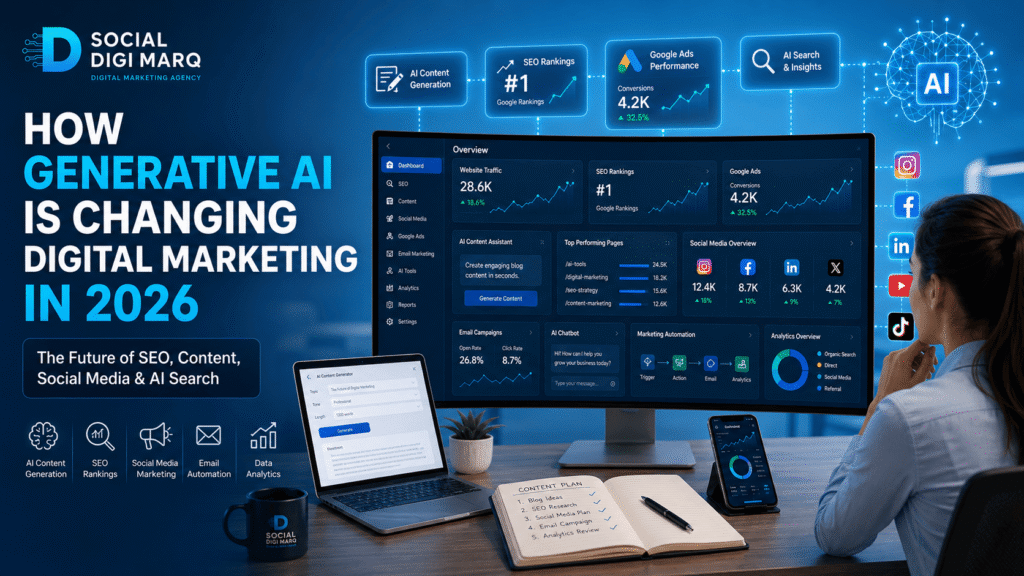
How Generative AI Is Changing Digital Marketing in 2026
Introduction
Digital marketing is evolving faster than ever before. Businesses are constantly looking for ways to create better content, improve customer experiences, increase efficiency, and generate more leads without dramatically increasing costs.
Over the past few years, artificial intelligence has moved from being a futuristic concept to becoming a practical business tool. In 2026, one branch of artificial intelligence is having a particularly significant impact on marketing: Generative AI.
From writing blog articles and creating social media posts to generating images, videos, ad copy, emails, and customer responses, Generative AI is transforming how marketers work.
For business owners, agencies, startups, freelancers, and marketing professionals, understanding how Generative AI is changing digital marketing is no longer optional. It has become an important competitive advantage.
The businesses that learn how to use AI effectively are often able to produce more content, respond faster to customers, improve campaign performance, and scale their marketing efforts more efficiently.
In this guide, we’ll explore how Generative AI is changing digital marketing in 2026, its benefits, challenges, practical applications, and what marketers should expect in the future.
What Is Generative AI?
Generative AI refers to artificial intelligence systems that can create new content based on user instructions, prompts, or existing data.
Unlike traditional AI systems that primarily analyze information, Generative AI can produce original outputs such as:
- Blog articles
- Marketing copy
- Social media posts
- Images
- Videos
- Audio
- Emails
- Chatbot responses
- Landing page content
- Product descriptions
Popular examples include:
- ChatGPT
- Gemini
- Claude
- Midjourney
- Adobe Firefly
- Runway
- Canva AI
These tools use advanced machine learning models trained on large amounts of data to generate human-like content.
Why Generative AI Matters in 2026
The digital marketing industry faces several ongoing challenges:
- Increasing content demands
- Rising advertising costs
- Growing competition
- Changing search behavior
- Limited marketing resources
Generative AI helps solve many of these problems.
Businesses can now:
- Produce content faster
- Automate repetitive tasks
- Improve personalization
- Scale campaigns efficiently
- Reduce production costs
As search engines and AI-powered search platforms continue evolving, marketers who understand AI workflows often gain a significant advantage.
The Rise of AI-Powered Search
Search behavior is changing dramatically.
Users increasingly rely on:
- Google AI Overviews
- ChatGPT Search
- Gemini
- Perplexity
- Bing Copilot
Instead of clicking through multiple websites, users often receive AI-generated answers directly.
This shift is changing how marketers approach:
- SEO
- Content marketing
- Website optimization
- User experience
Businesses must now optimize content not only for traditional search engines but also for AI-generated search experiences.
How Generative AI Is Different from Traditional AI
Many people use the terms AI and Generative AI interchangeably.
However, there are important differences.
| Traditional AI | Generative AI |
|---|---|
| Analyzes data | Creates content |
| Detects patterns | Generates new outputs |
| Predicts outcomes | Produces text, images, videos |
| Focuses on automation | Focuses on creation |
| Supports decisions | Generates marketing assets |
For example:
Traditional AI may identify that a particular advertisement performs well.
Generative AI can actually create multiple versions of that advertisement automatically.
This makes Generative AI especially valuable for digital marketing teams.
Why Marketers Are Adopting Generative AI
Generative AI provides benefits that directly impact marketing performance.
Faster Content Creation
Creating content manually can be time-consuming.
Generative AI helps marketers create:
- Blog outlines
- Article drafts
- Ad copy
- Email campaigns
- Social media captions
within minutes.
This allows businesses to maintain consistent publishing schedules.
Improved Productivity
Marketing teams often handle multiple responsibilities.
AI can automate repetitive tasks such as:
- Research
- Draft creation
- Content repurposing
- Reporting support
This allows teams to focus on strategy and creativity.
Cost Efficiency
Hiring specialists for every content format can become expensive.
Generative AI helps businesses create:
- Written content
- Visual assets
- Video concepts
- Marketing materials
more efficiently.
While AI doesn’t replace experts, it significantly reduces production time.
Better Personalization
Modern customers expect personalized experiences.
Generative AI can help create:
- Personalized emails
- Dynamic website content
- Customized recommendations
- Audience-specific messaging
This often leads to higher engagement and conversion rates.
A Practical Perspective
In our experience, many businesses initially adopt Generative AI to save time.
However, the biggest benefit is often consistency.
Businesses frequently struggle to publish content regularly because content creation requires significant effort.
Generative AI helps remove many of these bottlenecks.
For example, a digital marketing agency can use AI to:
- Generate blog outlines
- Create social media content
- Draft email campaigns
- Repurpose existing content
This allows teams to focus more on strategy, creativity, and client results.
The most successful marketers are not replacing human expertise with AI.
Instead, they are combining human experience with AI-powered efficiency.
Key Benefits of Generative AI in Digital Marketing
The biggest advantages include:
Faster Content Production
Produce content more efficiently.
Improved Marketing Efficiency
Reduce manual work.
Better Personalization
Deliver more relevant experiences.
Increased Scalability
Create more content without increasing workload.
Cost Reduction
Lower production expenses.
Enhanced Creativity
Generate ideas and inspiration quickly.
Improved Customer Engagement
Provide faster and more personalized interactions.
Who Should Use Generative AI?
Generative AI can benefit:
Business Owners
Improve marketing efficiency and lead generation.
Digital Marketing Agencies
Scale content production and campaign management.
Freelancers
Increase productivity while managing multiple projects.
Content Creators
Generate ideas and produce content faster.
E-commerce Brands
Create product descriptions, marketing assets, and customer communication.
Local Businesses
Improve online visibility and customer engagement.
What Makes Generative AI So Important for Digital Marketing?
The answer is simple.
Marketing today requires:
- More content
- Faster execution
- Better personalization
- Stronger customer experiences
Generative AI helps businesses meet these demands while remaining competitive.
However, the greatest results come from combining AI technology with human expertise, industry knowledge, and strategic thinking.
In the next section, we’ll explore exactly how Generative AI is transforming SEO, content marketing, social media marketing, Google Ads, Meta Ads, email marketing, customer support, and lead generation in 2026.
How Generative AI Is Transforming Digital Marketing in 2026
Generative AI is no longer limited to content writing.
Today, it is influencing almost every area of digital marketing, from SEO and content marketing to social media management, paid advertising, customer service, and lead generation.
Let’s explore the biggest transformations happening in 2026.
1. Generative AI and SEO
Search Engine Optimization has changed dramatically.
Traditional SEO focused heavily on:
- Keywords
- Backlinks
- Technical optimization
While these factors remain important, modern SEO now requires:
- Search intent optimization
- Topic authority
- User experience
- AI search optimization
Generative AI helps marketers improve all of these areas.
How AI Helps SEO
AI can assist with:
- Keyword research
- Topic clustering
- Competitor analysis
- Content optimization
- Meta title creation
- Meta description generation
- FAQ generation
- Schema recommendations
Example
Instead of spending hours researching keywords manually, marketers can use AI to identify:
- Long-tail keywords
- User questions
- Content gaps
- Trending topics
within minutes.
Generative AI and AI Search Optimization
Businesses now optimize content for:
- Google AI Overviews
- ChatGPT Search
- Gemini
- Perplexity
Generative AI helps structure content in ways that AI search engines can understand more effectively.
This includes:
- Question-based headings
- Detailed answers
- Topic clusters
- Conversational language
As AI search continues growing, this optimization becomes increasingly important.
2. Generative AI and Content Marketing
Content marketing is one of the biggest beneficiaries of Generative AI.
Creating high-quality content consistently has always been challenging.
AI helps marketers:
- Generate ideas
- Create outlines
- Draft articles
- Improve readability
- Repurpose content
faster than ever before.
AI-Powered Blog Creation
Businesses can use AI to:
- Generate blog topics
- Create article structures
- Write first drafts
- Build FAQ sections
- Optimize content
Expert Recommendation
AI should support content creation, not replace expertise.
The best-performing content combines:
- Human experience
- Industry knowledge
- AI efficiency
Content Repurposing
One blog post can become:
- LinkedIn posts
- Instagram captions
- Facebook posts
- Email newsletters
- YouTube scripts
- Short-form videos
Generative AI significantly increases content ROI.
3. Generative AI and Social Media Marketing
Social media requires constant content production.
Many businesses struggle to maintain consistency.
Generative AI helps marketers:
- Create captions
- Generate post ideas
- Write scripts
- Produce content calendars
- Analyze audience interests
AI for Social Media Content Creation
AI tools can create:
- Instagram captions
- LinkedIn posts
- Facebook content
- X (Twitter) updates
- YouTube descriptions
within seconds.
Benefits
- Faster production
- Better consistency
- More creative ideas
- Reduced workload
AI-Powered Social Media Planning
Generative AI can assist with:
- Monthly content calendars
- Campaign ideas
- Seasonal promotions
- Audience engagement strategies
This helps marketers stay organized and consistent.
4. Generative AI and Google Ads
Paid advertising is becoming more data-driven.
Generative AI helps advertisers create better campaigns faster.
AI Applications in Google Ads
AI can generate:
- Headlines
- Descriptions
- Landing page copy
- Call-to-actions
Example
A marketer can create multiple ad variations quickly and test performance more efficiently.
Better Ad Personalization
Generative AI helps create:
- Audience-specific messaging
- Personalized offers
- Dynamic ad copy
This often improves:
- Click-through rates
- Engagement
- Conversion rates
5. Generative AI and Meta Ads
Facebook and Instagram advertising continue evolving.
Generative AI supports:
- Ad creative generation
- Audience targeting ideas
- Campaign planning
- Ad copywriting
AI-Powered Ad Creative
Marketers can generate:
- Visual concepts
- Ad headlines
- Video scripts
- Carousel content
faster than traditional workflows.
This reduces production time while increasing creative testing opportunities.
6. Generative AI and Email Marketing
Email marketing remains one of the highest ROI marketing channels.
Generative AI helps improve:
- Subject lines
- Email copy
- Personalization
- Customer segmentation
AI-Powered Email Campaigns
AI can create:
- Welcome emails
- Promotional campaigns
- Follow-up sequences
- Lead nurturing emails
Example
An e-commerce brand can personalize emails based on customer behavior automatically.
This often leads to higher open rates and conversions.
7. Generative AI and Lead Generation
Generating quality leads is a major goal for most businesses.
Generative AI helps improve lead generation through:
- Personalized content
- AI chatbots
- Dynamic landing pages
- Automated communication
AI Chatbots
Modern AI chatbots can:
- Answer questions
- Qualify leads
- Book appointments
- Recommend services
24/7.
Benefits
- Faster responses
- Better customer experience
- Improved conversion rates
AI Landing Page Optimization
Generative AI can help create:
- Landing page copy
- CTA variations
- Conversion-focused messaging
This improves marketing efficiency.
8. Generative AI and Customer Experience
Customer experience directly affects:
- Engagement
- Retention
- Referrals
- Revenue
AI helps businesses provide more personalized experiences.
Personalized Content
AI can recommend:
- Products
- Services
- Blog posts
- Resources
based on user behavior.
This improves relevance and engagement.
Faster Customer Support
Businesses use AI to:
- Handle FAQs
- Resolve common issues
- Provide instant assistance
This improves customer satisfaction while reducing support costs.
9. Generative AI and Video Marketing
Video content continues dominating digital platforms.
Generative AI is making video production more accessible.
AI Video Applications
Businesses can generate:
- Video scripts
- Captions
- Voiceovers
- AI avatars
- Short-form videos
using tools like:
- Runway
- Synthesia
- Pictory
- CapCut AI
- Canva AI
Why This Matters
Video often generates:
- Higher engagement
- Better retention
- Stronger brand awareness
AI allows businesses to create more video content without increasing production costs.
Real-World Example
Imagine a digital marketing agency managing:
- SEO campaigns
- Social media accounts
- Google Ads campaigns
- Content marketing
for multiple clients.
Without AI:
Content production may take days.
With Generative AI:
- Blog outlines can be created quickly.
- Ad copy can be generated instantly.
- Social media calendars can be planned efficiently.
- Reports can be summarized automatically.
The result is greater efficiency and scalability.
Key Takeaway
Generative AI is not changing just one part of digital marketing.
It is transforming:
- SEO
- Content marketing
- Social media marketing
- Google Ads
- Meta Ads
- Email marketing
- Customer support
- Lead generation
- Video marketing
Businesses that learn how to use Generative AI strategically can often create more content, improve marketing performance, and deliver better customer experiences than competitors who rely entirely on manual processes.
In the next section, we’ll cover:
- Step-by-Step Guide to Using Generative AI in Marketing
- Best AI Marketing Tools
- Best Practices
- Real-World Case Study
- Expert Recommendations
- Common Implementation Strategies
Step-by-Step Guide to Using Generative AI in Digital Marketing
Understanding Generative AI is important, but the real value comes from implementing it effectively.
Many businesses know AI can help them save time, but they often struggle to build a practical workflow.
This section explains how marketers can integrate Generative AI into their daily operations.
Step 1: Define Your Marketing Goals
Before using any AI tool, identify your objectives.
Ask yourself:
- Do you want more website traffic?
- More leads?
- Better social media engagement?
- Higher Google rankings?
- More conversions?
Your goals determine how AI should be used.
Example
If your goal is SEO growth:
Use AI for:
- Keyword research
- Content creation
- Topic clustering
- Content optimization
If your goal is lead generation:
Use AI for:
- Landing pages
- Email campaigns
- Chatbots
- Personalized offers
Step 2: Use AI for Research
Research is one of the most time-consuming parts of marketing.
Generative AI can help marketers:
- Identify customer pain points
- Discover content opportunities
- Analyze competitors
- Generate keyword ideas
- Find emerging trends
Recommended Tools
- ChatGPT
- Claude
- Gemini
- Perplexity
Expert Recommendation
Always validate important information with trusted sources before publishing.
Step 3: Create Content Faster
Content remains one of the most important digital marketing assets.
Generative AI can help create:
- Blog posts
- Social media content
- Email campaigns
- Ad copy
- Landing page content
- Product descriptions
Example Workflow
- Research topic
- Generate outline
- Create draft
- Add expertise
- Optimize for SEO
- Publish
Important Note
The highest-performing content combines AI efficiency with human expertise.
Step 4: Repurpose Content Across Multiple Channels
One of the biggest advantages of Generative AI is content repurposing.
A single blog post can become:
- Instagram posts
- Facebook content
- LinkedIn articles
- Email newsletters
- YouTube scripts
- Short-form videos
This increases content ROI significantly.
Step 5: Improve Social Media Marketing
Social media requires consistent publishing.
AI can help marketers create:
- Content calendars
- Post ideas
- Captions
- Video scripts
- Audience engagement content
Example
A digital marketing agency can use Generative AI to create an entire month of social media content in a few hours instead of several days.
AI can suggest:
- Trending topics
- Hashtag ideas
- Engagement questions
- Reels concepts
- Carousel post structures
This allows marketers to spend more time interacting with audiences and improving campaign performance.
Step 6: Use Generative AI for Paid Advertising
Creating effective advertisements often requires multiple versions of ad copy and creative assets.
Generative AI helps marketers generate:
- Google Ads headlines
- Google Ads descriptions
- Meta Ads copy
- CTA variations
- Landing page content
Example
Instead of manually creating 20 ad variations, marketers can generate multiple options and test them quickly.
This improves campaign optimization and creative testing.
Step 7: Improve Email Marketing Performance
Email marketing continues to deliver one of the highest returns on investment in digital marketing.
Generative AI can help create:
- Welcome email sequences
- Promotional emails
- Newsletter content
- Follow-up campaigns
- Personalized customer messages
Practical Implementation
For example, an online store can use AI to create product recommendation emails based on customer interests and purchase behavior.
This improves engagement and conversion rates.
Step 8: Enhance Customer Support with AI
Customer expectations continue to rise.
People want immediate answers and quick solutions.
Generative AI can support customer service through:
- AI chatbots
- Automated FAQs
- Instant support responses
- Lead qualification systems
Benefits
- Faster response times
- Better customer experience
- Reduced support workload
- Increased lead generation opportunities
Step 9: Use AI for Analytics and Reporting
Data is one of the most valuable assets in marketing.
However, analyzing large amounts of information can be challenging.
Generative AI can help summarize:
- Campaign performance
- Traffic reports
- Advertising metrics
- Social media insights
- Customer behavior trends
Expert Recommendation
Use AI to simplify reporting, but always review important business decisions using verified data sources.
Best Generative AI Tools for Digital Marketing in 2026
Choosing the right tools is important.
Below are some of the most effective AI platforms used by marketers today.
ChatGPT
Best for:
- Content creation
- SEO research
- Marketing ideas
- Content planning
Claude
Best for:
- Long-form content
- Research
- Strategy development
Gemini
Best for:
- Google ecosystem integration
- Research
- Productivity workflows
Canva AI
Best for:
- Social media graphics
- Blog images
- Marketing materials
Midjourney
Best for:
- AI image generation
- Creative visuals
- Advertising concepts
Runway
Best for:
- AI video creation
- Video editing
- Marketing videos
Pictory
Best for:
- Converting blogs into videos
- Social media video content
CapCut AI
Best for:
- Reels
- YouTube Shorts
- TikTok videos
Best Practices for Using Generative AI in Marketing
Many marketers make the mistake of relying entirely on AI.
The best results come from combining technology with human expertise.
Always Add Human Experience
AI can generate information.
People provide:
- Experience
- Insights
- Strategy
- Creativity
Adding personal expertise improves trust and content quality.
Fact-Check Important Information
AI tools occasionally produce inaccurate information.
Always verify:
- Statistics
- Research
- Industry data
- Technical recommendations
before publishing.
Focus on User Intent
Successful marketing content solves problems.
Instead of creating content purely for keywords, focus on:
- User questions
- Customer pain points
- Practical solutions
This approach aligns with Google’s Helpful Content principles.
Optimize for AI Search
As AI search grows, content should include:
- Clear headings
- FAQ sections
- Direct answers
- Topic depth
- Conversational language
This helps visibility in:
- Google AI Overviews
- ChatGPT Search
- Gemini
- Perplexity
Maintain Brand Consistency
AI-generated content should always match:
- Brand voice
- Company values
- Audience expectations
Consistency builds credibility and trust.
Real-World Case Study
Business Type
Digital Marketing Agency
Challenge
The agency wanted to publish more content, improve client reporting, and increase lead generation without significantly expanding the team.
Solution
The agency integrated Generative AI into its workflow.
AI Tools Used
- ChatGPT
- Canva AI
- Gemini
- Pictory
Workflow
- Research content ideas with AI.
- Generate article outlines.
- Create first drafts.
- Design visuals using Canva AI.
- Convert blog content into videos.
- Distribute content across multiple platforms.
Results
Within several months:
- Increased content output
- Improved workflow efficiency
- Faster campaign execution
- Better audience engagement
Most importantly, the team gained more time to focus on strategy and client relationships.
Key Takeaway
Generative AI is most effective when used as a marketing assistant rather than a replacement for human expertise.
Businesses that build smart AI-powered workflows can:
- Create content faster
- Improve marketing efficiency
- Generate more leads
- Enhance customer experiences
- Scale operations more effectively
In the final section, we’ll cover:
- Common Mistakes to Avoid
- Future Trends in Generative AI
- Internal Link Opportunities
- External Resources
- Conclusion
- FAQs
- Extra Rank Math Optimization Paragraph
Common Mistakes to Avoid When Using Generative AI in Digital Marketing
Generative AI is a powerful tool, but many businesses fail to maximize its potential because they use it incorrectly.
Here are some of the most common mistakes marketers make.
Mistake 1: Publishing AI Content Without Human Editing
Why It Happens
Businesses try to save time by publishing AI-generated content directly.
Impact
Content may sound generic, contain inaccuracies, and fail to build trust.
Solution
Always review, edit, and improve AI-generated content with your expertise, experience, and brand voice.
Mistake 2: Ignoring Search Intent
Why It Happens
Marketers focus only on keywords.
Impact
Content ranks poorly and fails to convert visitors.
Solution
Understand what users actually want when they search and create content that answers their questions clearly.
Mistake 3: Over-Relying on Automation
Why It Happens
Businesses assume AI can replace strategy.
Impact
Marketing loses authenticity and creativity.
Solution
Use AI to improve efficiency while keeping humans responsible for strategy, creativity, and decision-making.
Mistake 4: Not Fact-Checking AI Output
Why It Happens
Users trust every AI-generated response.
Impact
Publishing inaccurate information can damage credibility.
Solution
Verify statistics, industry information, and technical details before publishing.
Mistake 5: Creating Low-Quality Content at Scale
Why It Happens
AI makes content production faster.
Impact
Publishing large amounts of weak content often leads to poor engagement and weak SEO performance.
Solution
Prioritize quality, expertise, and usefulness over quantity.
Mistake 6: Ignoring Brand Voice
Why It Happens
AI content is used without customization.
Impact
Marketing becomes inconsistent and less memorable.
Solution
Train AI outputs to match your brand personality and communication style.
Mistake 7: Failing to Optimize for AI Search
Why It Happens
Businesses focus only on traditional SEO.
Impact
Reduced visibility in AI-powered search platforms.
Solution
Create content with:
- Clear headings
- FAQs
- Structured answers
- Topic depth
- Expert insights
to improve visibility in AI search engines.
Future Trends in Generative AI and Digital Marketing
Generative AI is evolving rapidly.
The next few years will bring significant changes to how businesses market online.
Hyper-Personalized Marketing
AI will create personalized experiences for individual users.
Examples include:
- Personalized emails
- Dynamic landing pages
- Customized product recommendations
- Individualized advertisements
This will improve engagement and conversion rates.
AI Search Optimization Will Become Standard
Businesses will increasingly optimize content for:
- Google AI Overviews
- ChatGPT Search
- Gemini
- Perplexity
- Bing Copilot
AI visibility will become just as important as traditional SEO.
AI-Powered Video Creation
Video production will become faster and more affordable.
Businesses will use AI for:
- Video scripts
- Voiceovers
- AI avatars
- Video editing
- Content repurposing
This will increase the importance of video marketing.
Smarter Marketing Automation
AI systems will manage more complex workflows including:
- Lead nurturing
- Customer segmentation
- Campaign optimization
- Predictive analytics
Marketers will spend less time on repetitive tasks and more time on strategic growth.
Voice Search and Conversational Marketing
As voice assistants become more advanced, content will need to be optimized for conversational queries.
Businesses that adapt early will gain a competitive advantage.
Link Suggestions
Add these links naturally throughout the article.
SEO Services
Google Ads Services
Google Ads Management Services
Social Media Marketing Services
Social Media Marketing Services
Content Creation Services
WordPress Development Services
WordPress Development Services
AI Search Blog
How to Rank in Google AI Search
GEO Blog
GEO vs SEO: What’s the Difference in 2026?
AI Tools Blog
Best AI Tools for WordPress Website Owners in 2026
External Link Suggestions
OpenAI
Google Search Central
https://developers.google.com/search
Google Trends
Google Business Profile
https://www.google.com/business
Meta Business
Anthropic
Google Gemini
Conclusion
Generative AI is fundamentally changing digital marketing in 2026.
From SEO and content marketing to social media management, advertising, customer support, and lead generation, AI is helping businesses work smarter and scale faster.
The most successful marketers are not using AI to replace people.
They are using AI to enhance productivity, improve creativity, and make better decisions.
Businesses that embrace Generative AI strategically can:
- Produce more content
- Improve customer experiences
- Increase efficiency
- Generate more leads
- Stay competitive in AI-powered search environments
However, success still depends on human expertise.
Experience, strategy, creativity, and authenticity remain essential.
The future belongs to businesses that combine human intelligence with artificial intelligence.
Action Steps
- Identify repetitive marketing tasks.
- Choose the right AI tools.
- Build an AI-powered workflow.
- Optimize content for AI search and traditional SEO.
- Track performance and improve continuously.
By following these steps, businesses can position themselves for long-term success in the rapidly evolving digital marketing landscape.
FAQs
What is Generative AI in digital marketing?
Generative AI refers to artificial intelligence systems that can create content such as text, images, videos, emails, advertisements, and marketing assets.
How is Generative AI changing SEO?
Generative AI helps with keyword research, content creation, topic clustering, AI search optimization, and content personalization.
Can Generative AI replace digital marketers?
No. AI improves efficiency, but strategy, creativity, relationship building, and decision-making still require human expertise.
What are the best Generative AI tools for marketers?
Popular tools include ChatGPT, Claude, Gemini, Canva AI, Midjourney, Runway, Pictory, and CapCut AI.
How does Generative AI help social media marketing?
AI can generate captions, content calendars, post ideas, video scripts, and engagement content more efficiently.
Is Generative AI useful for small businesses?
Yes. Small businesses can use AI to create content, improve marketing efficiency, automate tasks, and compete more effectively with larger brands.
How does Generative AI affect Google Ads?
AI helps generate ad copy, create multiple ad variations, improve personalization, and support campaign optimization.
What is the future of Generative AI in marketing?
The future includes AI-powered search optimization, personalized customer experiences, advanced automation, AI-generated videos, and smarter marketing workflows.
If Rank Math shows low keyword density, add this paragraph before the conclusion:
Many businesses are still exploring how Generative AI in Digital Marketing can improve their results. In our experience, the biggest advantage is not simply creating content faster. The real value comes from improving consistency, productivity, and customer engagement. When used strategically, Generative AI in Digital Marketing helps businesses publish valuable content more frequently, optimize marketing campaigns more efficiently, and adapt to changing customer expectations. Companies that learn how to use Generative AI in Digital Marketing effectively today will be better prepared for the future of online marketing.